Google Ads customer lifecycle goals: 3 updates for October

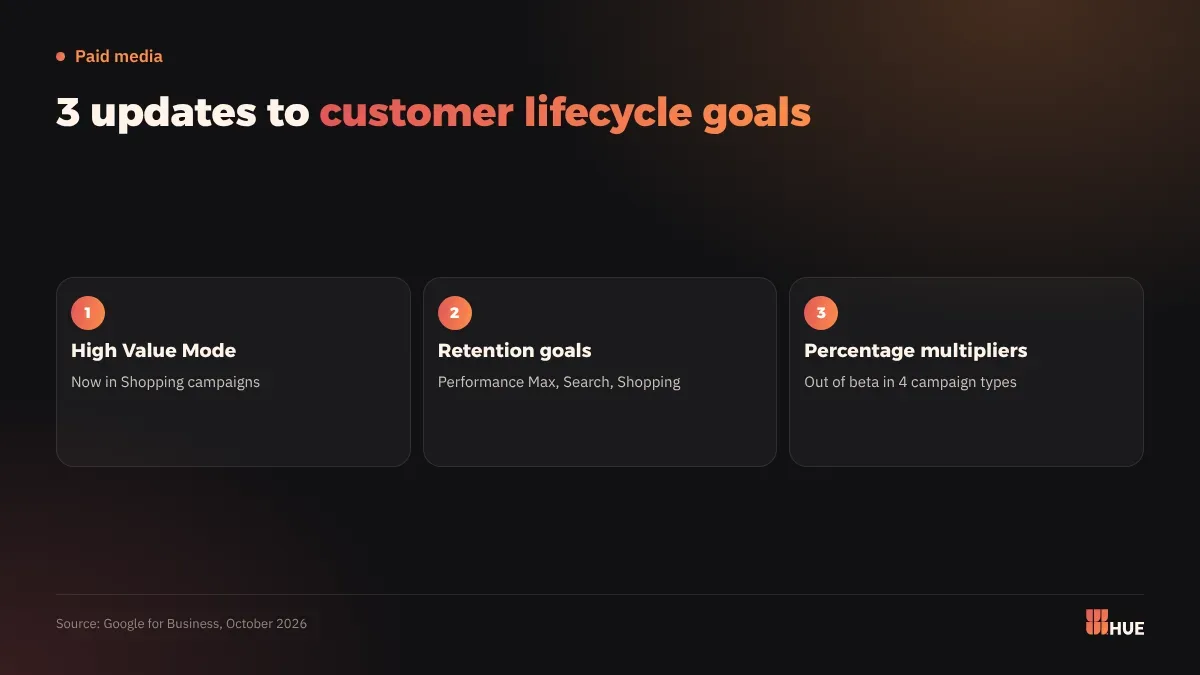
On October 22, 2026, Google announced three updates to Google Ads customer lifecycle goals, all rolling out to accounts this month. High Value Mode now works in Shopping campaigns, retention goals open up for Performance Max, Search and Shopping, and percentage multipliers leave beta. Google published the details in an article on Google for Business, and Search Engine Roundtable covered it the same day.
Customer lifecycle goals are Smart Bidding settings that tell Google which customers you will pay more to reach: new customers, past customers who stopped buying, or loyalty program members. Bids go up for the group you pick, as the Google Ads help page explains.
What changed in Google Ads customer lifecycle goals?
Three settings changed, and each one covers a different set of campaign types.
- High Value Mode in Shopping: it already worked in Search and Performance Max. It splits bidding into three tiers: high-value new customers, regular new customers, and existing customers. You decide what "high value" means; Google's example is a customer who buys twice as much as others.
- Retention goals: after a beta, they roll out this month to Performance Max, Search and Shopping, with three modes shown in the table.
- Percentage multipliers: the bid boost grows with cart size instead of adding a flat amount. In Google's example, a jewelry shop sets a 20% (1.2x) boost, so it bids as hard on a $500 cart as on a $50 one. They cover Search, Shopping, Performance Max and Demand Gen, in Google Ads and SA360.
| Retention mode | Who it targets | Ads keep running for everyone else? |
|---|---|---|
| Re-engagement | Customers who haven't ordered in a while | Yes |
| Loyalty | Loyalty program members | Yes |
| Retention Only | Only the segments you specify | No |
How do acquisition goals differ from retention goals?
Acquisition goals bring in new customers; retention goals bring back people who bought before. The help page lists three acquisition settings:
- New Customer Value: bids more for a new customer than an existing one. Google recommends it for every advertiser with a purchase goal.
- High Value New Customer: the three-tier setup that has now reached Shopping.
- New Customer Only: bids on new customers alone. Google suggests it only for strict acquisition budgets or non-purchase goals such as lead generation.
Retention goals work on customers you already know. You upload a list through Customer Match, and Google bids higher when your ad can reach one of them.
Is the update available in Saudi Arabia and Egypt?
Google has not named Saudi Arabia or Egypt. The announcement sits on the US edition of Google for Business and does not say which countries get the update. The only regional limit on the help page covers pairing new-customer campaigns with first-order promotions in Merchant Center, which works in the US only.
Open the goal settings in your campaign and check that the option appears in your account before you plan around it.
What do retention goals mean for an online store?
You can pay more for the customers who matter to you and keep normal bids for people who would buy anyway. That depends on your customer data.
- A store on Salla, Zid or Shopify with buyers from last year who never came back can use Re-engagement to bid higher on them while ads keep running for everyone else.
- A store with a points or membership scheme can send member pricing to members through Loyalty mode.
- A store selling both devices and accessories gains from a percentage multiplier, because a flat boost adds the same amount to a small cart and a large one.
Value-based settings need at least one Purchase conversion goal, according to the help page. Google identifies your existing customers from your customer list and website tag. An account that does not track purchases cannot use the value-based settings.
All of these settings sit on top of Smart Bidding, so read our piece on the Smart Bidding learning period before you change a campaign that is working.
What should you do before the sale season?
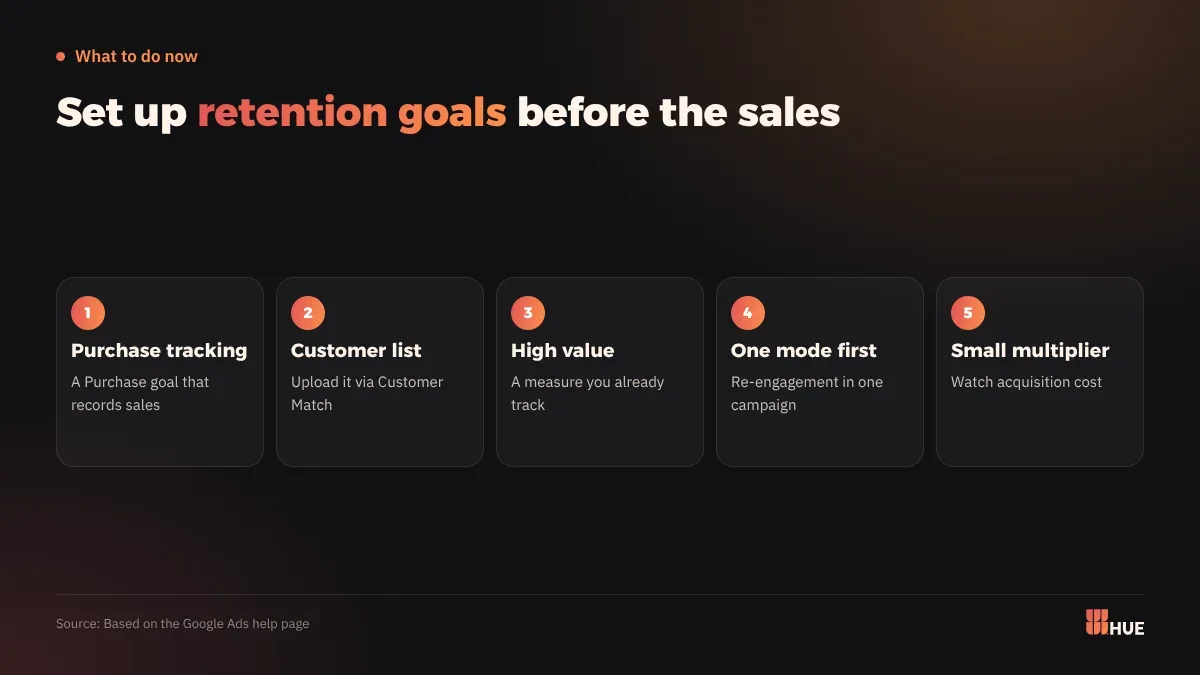
Five steps are enough for this week:
- Check purchase tracking: make sure a Purchase goal exists in the account and is recording conversions.
- Refresh your customer list: export buyers from your store, upload them through Customer Match, and keep lapsed buyers in a separate list.
- Define "high value" for your business: pick a measure you already track, such as average order value or orders per year.
- Turn on one mode: start with Re-engagement in one Performance Max or Shopping campaign and leave the rest alone until you see results.
- Test a small percentage multiplier: if your cart values vary widely, set a low percentage and watch acquisition cost before raising it.
Questions
What are Google Ads customer lifecycle goals?
Smart Bidding settings that raise bids for a group you choose: new customers, past customers who stopped buying, or loyalty program members.
Do I need purchase tracking to use retention goals?
Yes for the value-based settings, which need at least one Purchase conversion goal. Google also needs a customer list or website tag to know who your existing customers are.
Are retention goals available in Saudi Arabia and Egypt?
Google did not list countries in its announcement and said the rollout starts in October 2026. Check the goal settings in your campaign to see whether the option appears.