Smart Bidding learning: the 7-day cap and what triggers it

Google has rewritten its help page on Smart Bidding learning and renamed it "About Smart Bidding learning". Search Engine Roundtable spotted the change on October 21, 2026. The new Google Ads help page says the "Learning" status never lasts more than 7 days, and it names only three things that put a bid strategy into that status.
If you have been holding off on a budget increase or a target change because you were afraid of "resetting learning", the new page says those edits do not trigger Learning and do not remove historical data.
What is Smart Bidding learning? It is a status that appears in a bid strategy's status column after a structural change to a campaign or bid strategy. It lasts 7 days at most, and ads keep serving normally while it shows, according to Google. Hotel campaigns don't display it.
What changed on the Smart Bidding learning page?
Two things changed. The visible status now has a stated ceiling of 7 days, and Google separates that status from the time performance needs to settle.
- The page used to be called "Duration of the learning period for campaigns and what affects it". It is now "About Smart Bidding learning", as Search Engine Roundtable reported.
- The Learning status never runs past 7 days, and ads serve during it.
- Performance usually converges on a new goal within 1 to 2 conversion cycles, sometimes faster when there is more conversion data.
- Google names three factors that decide how fast that happens: conversion volume, conversion cycle length and campaign settings. A very tight target, a low budget or narrow targeting slows it down.
- The page also adds an FAQ section and practical advice for managing campaigns.
A conversion cycle is the usual gap between a customer clicking an ad and buying or getting in touch. It gets longer when customers think hard before buying, as with property.
What puts a campaign into Learning?
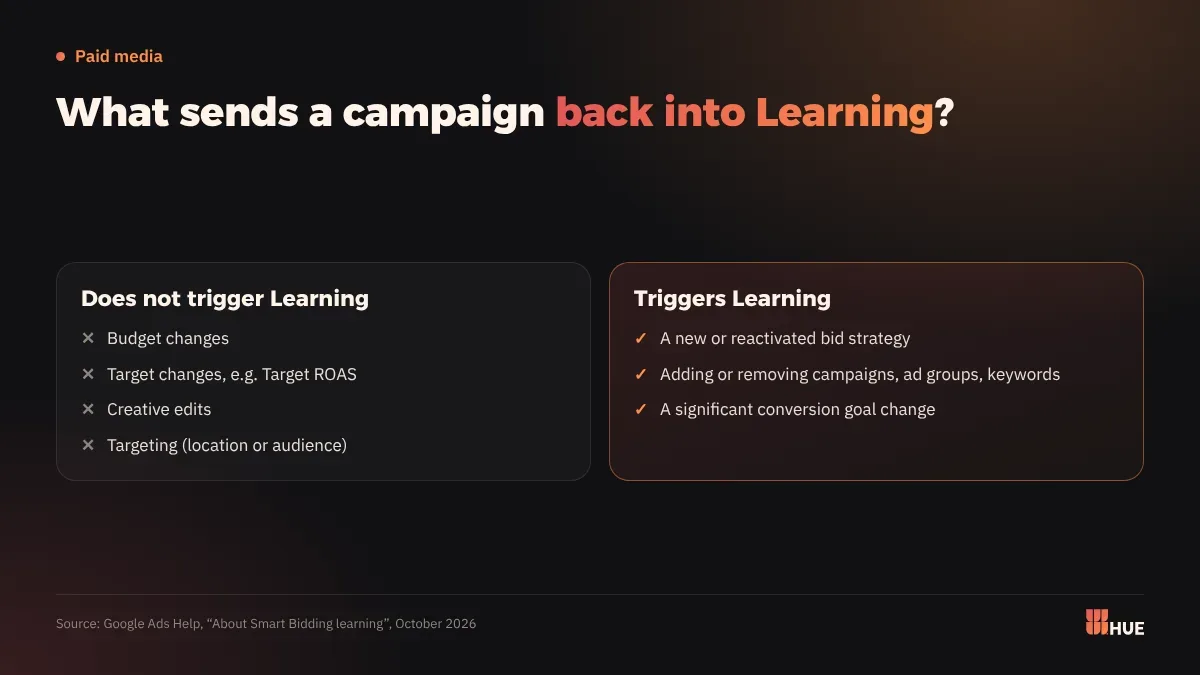
A bid strategy enters Learning in three cases only:
- New strategy: you created a bid strategy or reactivated one.
- Composition change: you added campaigns, ad groups or keywords to the strategy, or removed them.
- Goal change: you made a significant change to the conversion goals or actions the campaign optimizes for.
Google adds that applying a new portfolio bid strategy can put campaigns into Learning for up to 7 days, with a faster ramp-up when they have conversion history.
What does not trigger Learning?
Changes to budgets, targets, creatives or targeting (such as location or audience) do not trigger Learning and do not wipe historical data. A target change, for example to Target ROAS, takes effect immediately, but performance moves toward it gradually over the conversion cycle without the Learning label. New or edited ads still go through the usual policy review before they serve.
What does this mean for businesses in Saudi Arabia and Egypt?
Raising a budget before a sale season will not send your campaign back to the start. The real risk sits in restructuring the account and changing the conversion goal. The page is published in English in the Google Ads Help Center, it names no regional or language exception, and Google has not announced a separate date for Saudi Arabia or Egypt.
- Splitting campaigns has a cost. Every campaign or ad group you add to a strategy enters Learning, and Google recommends consolidating campaigns and ad groups so conversion data pools in one place. If your account gets few conversions, splitting it into one campaign per city or per product spreads that thin data across more campaigns.
- Changing the conversion goal is a big move. Switching from optimizing for WhatsApp button clicks to optimizing for store purchases, for example, counts as a goal change. Plan it, and don't repeat it every week.
- CPC and CTR may swing. Google says Smart Bidding optimizes for the primary goal, so cost per click or click-through rate can move after Learning ends without the campaign failing.
What should you do now to manage Smart Bidding learning?
Start this week with the campaigns that spend the most.
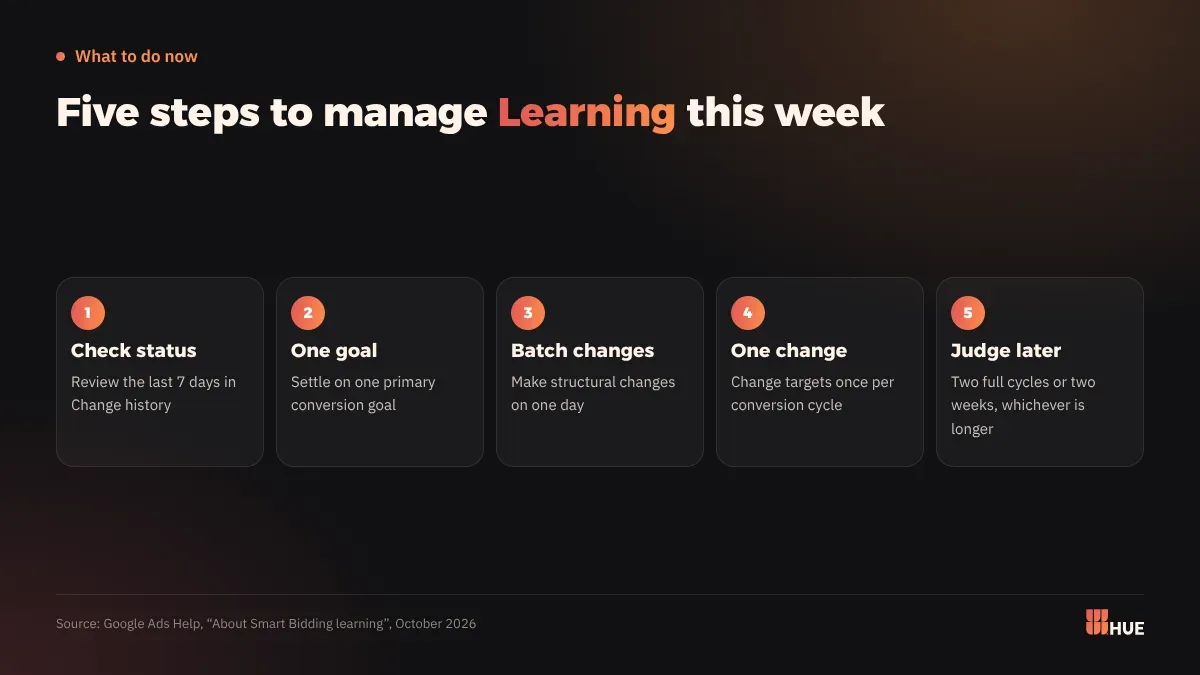
- Check each strategy's status. Open the bid strategy status column, then use Change history to see what you edited in the last 7 days on any campaign that shows Learning.
- Settle on one primary conversion goal. Google recommends optimizing to one consistent primary goal and sending conversion data regularly. If you are not sure your tracking is accurate, read Accurate conversion tracking: pixel, Conversions API and GA4 in plain language.
- Batch structural changes. If you plan to add campaigns, ad groups or keywords to a strategy, add them on one day instead of spreading them across a week.
- Change targets once per conversion cycle. Google advises against several target changes within one cycle unless there is a clear business reason. Keep daily budgets high enough for the system to work.
- Judge results at the right time. Wait 1 to 2 conversion cycles, then evaluate over two full cycles or two weeks, whichever is longer, allowing for delayed conversions.
Questions
How long does Smart Bidding learning last?
At most 7 days, according to the Google Ads help page, and ads serve normally during it. Performance usually settles on a new goal within 1 to 2 conversion cycles.
Does raising my budget put a campaign back into Learning?
No. Google says changes to budgets, targets, creatives or targeting do not trigger Learning or remove historical data.
When should I judge a new bid strategy?
Google suggests waiting 1 to 2 conversion cycles, then evaluating over 2 cycles or 2 weeks, whichever is longer, allowing for delayed conversions.