Organising the clinic waiting room: online booking and call screens in 2026

A crowded waiting room, a patient asking every ten minutes how many are still ahead, a receptionist calling names out loud: a familiar scene in many Egyptian clinics. But the patient experience doesn't start at the waiting-room door; it starts at the moment of booking. When a patient books a real slot from their phone, gets a confirmation, and is then called on a clear screen, their impression of the whole clinic changes.
Why does the waiting experience affect which clinic patients choose?
Because patients see waiting as part of the medical service. In a study of 459 outpatients at a general hospital in Cairo, "time with the doctor" was among the weakest satisfaction areas (2.96 out of 5). At Banha University Hospital, only about half of patients were satisfied with how the queue was managed.
Both studies were in hospitals rather than private clinics, but they reveal what bothers Egyptian patients: an unclear queue and a sense that their time isn't respected. There is no published Egyptian study measuring average waiting minutes in private clinics.
Are Egyptian patients ready for online booking?
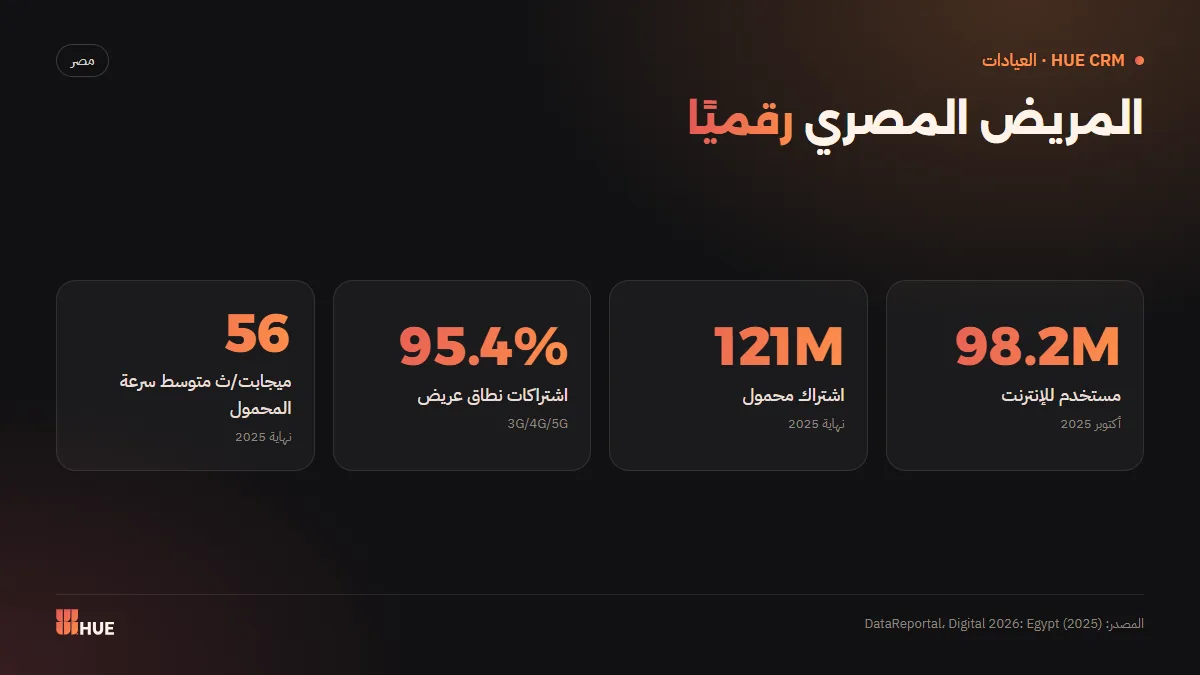
Yes; the digital infrastructure is there. According to DataReportal, Egypt had 98.2 million internet users (82.7% of the population) in October 2025, 121 million mobile connections, 95.4% of connections on broadband, and a median mobile download speed of 56.45 Mbps.
From patients themselves: a 2020 Egyptian survey of 686 patients at university hospitals in eight governorates found that half had used a telemedicine tool before and 60.8% preferred it to traditional routes. The sample isn't representative of all of Egypt, but it points to clear acceptance of digital health services.
What is the difference between a real booking page and a booking request form?
A real booking page reads the clinic's schedule directly and shows genuinely free slots, so the patient picks a time and the booking is fixed. A request form only collects details, and the receptionist then calls the patient to agree a time. The difference is a booking in one minute versus hours of back-and-forth calls.
| Criterion | Booking page with real slots | Booking request form |
|---|---|---|
| What the patient sees | Genuinely free slots or a queue number | Fields for their details only |
| Booking confirmation | Immediate after choosing | After a call from reception |
| Risk of double booking | Low, because it reads the schedule | High with manual booking |
| Reception workload | Lower | Extra calls |
| Confirmation to the patient | Automatic message | Depends on staff |
In HUE CRM for Clinics, the online booking page shows real free slots so the patient picks their own time, or books by queue if the clinic works with numbers. They then get a WhatsApp confirmation and a reminder the day before.
What does the patient journey look like in a digital clinic?
Five connected stops: the patient books from their phone, gets a confirmation, is checked into the waiting list on arrival, is called on the waiting-room screen with an Arabic voice, and receives a follow-up and review request after the visit. Each stop removes a question, a phone call or a crowd at the front desk.
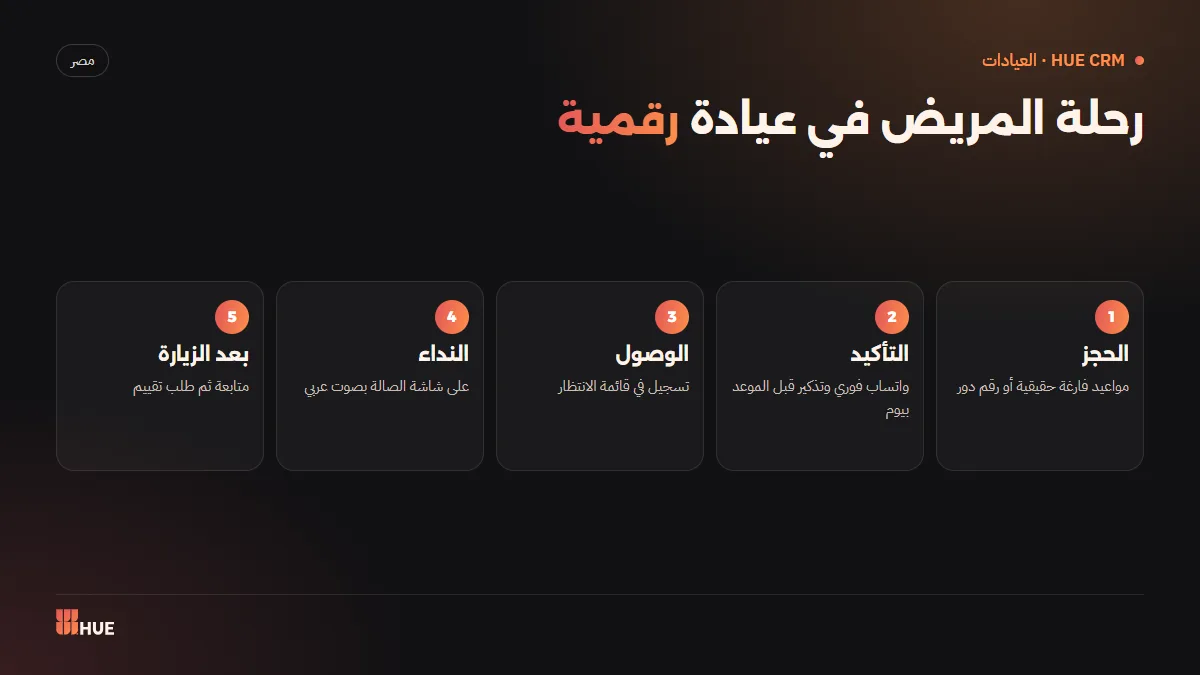
- Booking: from the clinic's online page, choosing a real free slot or a queue number.
- Confirmation: an instant WhatsApp message with the details, then a reminder the day before.
- Arrival: reception checks the patient in, and they join the waiting list in order.
- Calling: the name or number appears on the waiting-room screen with an Arabic voice call.
- After the visit: a follow-up message, then a review request that supports the clinic's reputation.
What does a patient call screen with Arabic voice add?
A call screen makes the queue visible to everyone: patients see who is being called now and hear their name or number in a clear Arabic voice, so there are fewer repeated questions at reception and less shouting. It also signals that the clinic is organised and respects patients' time.
- A clear queue instead of guessing and repeated questions.
- A calmer waiting room, because calling is orderly.
- More time for reception to register, collect payments and answer the phone.
- A professional impression that shows up in patient reviews.
All you need is a TV in the waiting room showing the HUE CRM call screen, linked to the same waiting list that reception and the doctor work from.
How do Universal Health Insurance and digitisation affect private clinics?
Universal Health Insurance is expanding governorate by governorate, and the state is moving towards a unified electronic medical record. That doesn't mean every private clinic is affected the same way, but it does mean patients are getting used to organised, digital health services and will compare every clinic they visit against them.
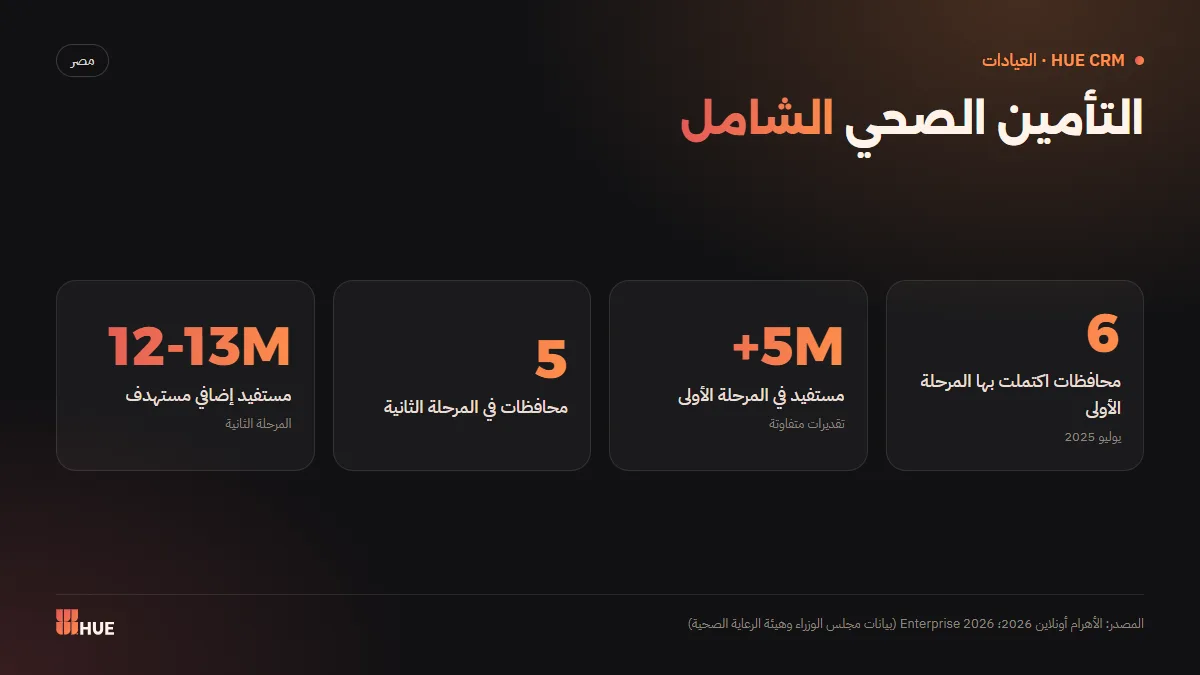
| Milestone | What happened |
|---|---|
| July 2019 | Pilot launch in Port Said |
| July 2025 | Phase one completed with Aswan, covering 6 governorates: Port Said, Ismailia, Luxor, South Sinai, Suez and Aswan |
| 2025–2026 | Over 5 million beneficiaries in phase one (estimates range from 5.2 to 5.4 million) |
| Phase two | Minya, Matrouh, Damietta, Kafr El Sheikh and North Sinai: about 12–13 million more beneficiaries, 69 hospitals and 669 primary-care units |
Sources differ on when nationwide coverage will be complete, between 2027 and 2032. In parallel, the Ministry of Health and Population announced the National Digital Health Strategy 2025–2029 in November 2025, and in July 2026 the ministry's spokesman said work was moving ahead on a unified electronic medical record for every patient.
To be clear: HUE CRM manages a private clinic from the inside and is not connected to Universal Health Insurance or any government system. But a clinic that runs on electronic files and organised booking today will be better prepared for whatever digital requirements come later.
How can you start organising your waiting room this week?
Start with small, sequential steps: switch on the online booking page and share its link, then confirmation and reminder messages, then the waiting list, and finally the call screen in the waiting room. Within a week the waiting room can look different without changing how the doctor works.
- Decide on the right booking model: timed slots or queue.
- Switch on the booking page and add its link to your pages and the clinic's WhatsApp account.
- Turn on the confirmation and the day-before reminder.
- Train reception to check patients into the waiting list.
- Run the call screen on the waiting-room TV.
- Review patient feedback after a month.
To cut the missed appointments that disrupt the schedule, see the article on reducing no-shows with WhatsApp reminders, and to control the cash these visits bring in, read the clinic revenue and expenses guide.
Where should you publish your clinic's online booking link?
Put the link where patients actually look for you: your clinic's Google Maps profile, the clinic's Facebook and Instagram pages, the WhatsApp auto-reply, and a QR code on the printed clinic card. Every place the link appears means one less call to reception and a faster booking for the patient.
- Your Google Maps profile: often the first thing patients see when searching for a nearby doctor.
- Social media pages: in the bio and in pinned posts.
- The WhatsApp greeting message: so patients book themselves instead of waiting for a reply.
- A QR code in the clinic: on the reception desk, to book the follow-up before leaving.
- The follow-up slip or appointment card: so the patient finds the link when they need it.
How should you handle patients who arrive without a booking?
Walk-ins can't be eliminated in many Egyptian clinics, and they shouldn't be. The answer is to add walk-in patients to the same waiting list in a clear order, so everyone sees the queue on the screen and patients with appointments know their slot is protected. Clarity prevents a sense of unfairness in the waiting room.
- Reception adds the patient to the waiting list as soon as they arrive.
- The patient is told roughly where they are in the queue.
- The clinic sets a stated rule for balancing booked patients and walk-ins.
- The patient is encouraged to book online next time via a link or QR code.
Conclusion
Organising the waiting room doesn't start with more chairs; it starts with clearer booking and a visible queue. Egyptian patients are online, the health system is going digital, and a clinic that offers real booking, confirmations and a call screen earns an impression that is hard to compete with. To choose the right system against every criterion, read the guide to choosing clinic management software in Egypt.
Sources
- Egyptian Journal of Nursing and Health Sciences — Outpatient satisfaction at a general hospital in Cairo
- Ain Shams University — Queue management and outpatient satisfaction (Banha University Hospital)
- DataReportal — Digital 2026: Egypt, 2025
- National survey — Knowledge, applicability and barriers of telemedicine in Egypt (2020 data)
- Ahram Online — UHIS in the Canal Region, 2026
- Ahram Online — Minya UHIS trial operations, 2026
- Enterprise — Egypt prepares to double Universal Health Insurance reach, 2026
- EMPHNET — Egypt unveils National Digital Health Strategy 2025–2029, 2025
- MEA Tech Watch — Egypt reviews progress of digital health projects, 2026
Questions
Does online booking suit clinic patients in Egypt?
Yes. Egypt had 98.2 million internet users (82.7% of the population) in October 2025 according to DataReportal, and patients can book from their phone in a minute.
Does the HUE CRM booking page show real free slots?
Yes. It reads the clinic's schedule and shows genuinely free slots so patients pick their own time, or book by queue number if the clinic works that way.
What does a patient call screen with Arabic voice add?
It makes the queue visible and audible to everyone, reducing repeated questions at reception and loud calling, and gives the clinic an organised feel.
What do I need to run the call screen?
A TV in the waiting room showing the HUE CRM call screen, linked to the waiting list that reception and the doctor work from.
Is HUE CRM connected to Universal Health Insurance?
No. It manages the private clinic from the inside and isn't connected to any government system, though working with electronic files leaves a clinic better prepared for digital change.
Which governorates does Universal Health Insurance cover so far?
Phase one is complete in Port Said, Ismailia, Luxor, South Sinai, Suez and Aswan, and phase two covers Minya, Matrouh, Damietta, Kafr El Sheikh and North Sinai.