Managing clinic revenue and expenses: where does your clinic's money go?

Many busy clinics don't know their real profit at the end of the month. Visits are plentiful and the cash drawer fills and empties, but nobody can say precisely how much came in today, how much went out, and who still owes money. This guide gives clinic owners and medical centre managers a simple system for controlling money, from the first invoice to the month-end report.
In this guide:
- Why cash control is a particular priority for Egyptian clinics.
- Where clinic revenue usually leaks.
- A daily cash-closing routine and five weekly indicators.
- Managing surgery bookings with deposits, and staff attendance.
Why is cash control a priority for clinics in Egypt?
Because Egyptian patients usually pay out of pocket, in cash, at the front desk. According to the World Bank, out-of-pocket payments made up about 59.3% of current health expenditure in Egypt in 2020, and have stayed between 55% and 63% since 2011. That means a large share of clinic revenue passes through the receptionist's hands.
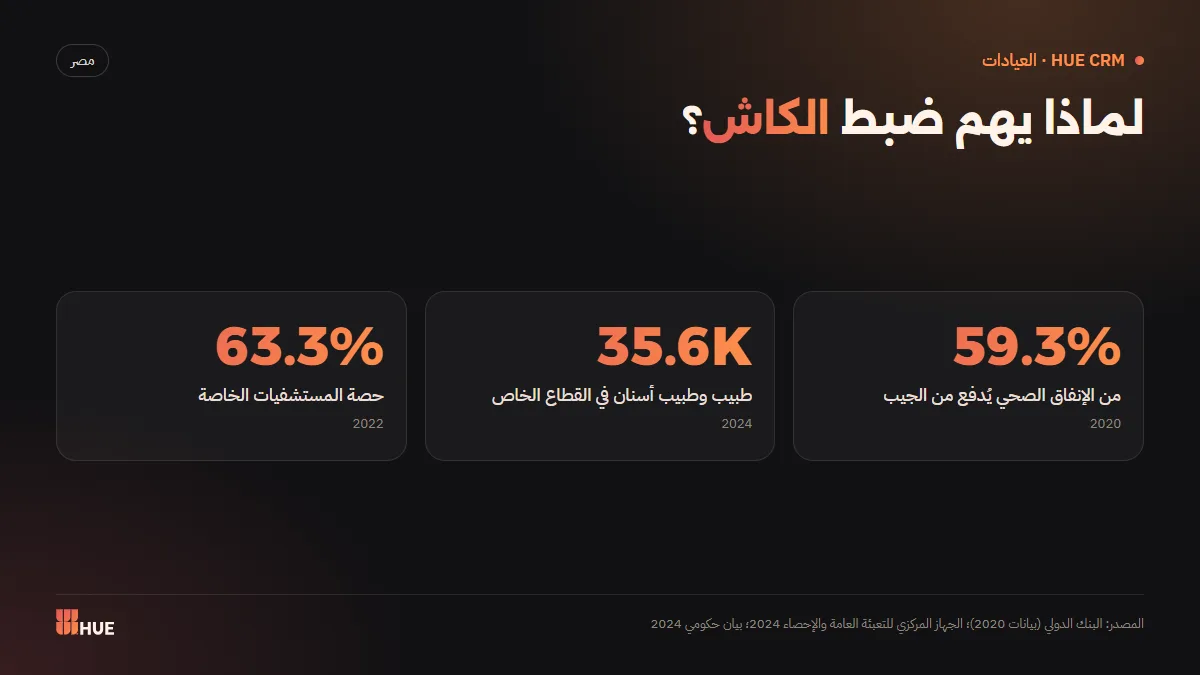
At the same time, competition is growing. According to CAPMAS, private-sector doctors and dentists rose to 35.6 thousand in 2024, up 2.1% on 2023. Private hospitals made up 63.3% of all hospitals in 2022, according to a government statement. More competition means less room for error in managing money.
Where does clinic revenue usually leak?
Leakage is rarely one large sum. It's small, repeated amounts: a patient who didn't show up, a visit with no invoice, a follow-up the patient was never reminded about, a surgery cancelled without a deposit, and working hours nobody can verify. Add these up over a month and you'll find the difference between a profitable clinic and a struggling one.
| Leak | How it happens | What helps reduce it |
|---|---|---|
| No-shows | Empty slots with no revenue | WhatsApp confirmations and reminders |
| Visits without invoices | Unrecorded cash collection | An invoice per visit and a daily close |
| Forgotten follow-ups | The patient doesn't come back on time | A follow-up message after the visit |
| Cancelled surgeries | Theatre and team booked with no commitment | Booking surgeries with a deposit |
| Scattered expenses | Small purchases never recorded | Recording every expense under a category |
| Unclear working hours | Lateness and absence with no record | Attendance by location |
In many clinics the biggest of these is no-shows: the global average is about 23%, according to a 2018 systematic review. We cover it in a full article with a worked example: how to reduce no-shows with WhatsApp reminders.
How do you control the cash drawer every day?
With a fixed five-step routine at the end of each day: match invoices to visits, total payments by method, record expenses, review balances patients still owe, then have the responsible person sign off the close. Ten minutes a day saves you from month-end surprises.

- Match visits to invoices: every patient seen should have an invoice.
- Total payments by method: cash, transfer or other.
- Record the day's expenses under categories: supplies, maintenance, hospitality and so on.
- Review outstanding balances for patients who paid only part.
- Sign off the close after matching actual cash against what the system recorded.
In HUE CRM for Clinics, invoices, payments and expenses are recorded in the same system as bookings and consultations, so reports come from one source instead of scattered notebooks.
Which financial indicators should a clinic owner review weekly?
Five indicators are enough to know your clinic's financial health: average revenue per visit, attendance rate, revenue per doctor, outstanding patient balances, and expenses as a share of revenue. Review them weekly and compare with the previous week; the trend matters more than any single number.
| Indicator | How to calculate it | What it tells you |
|---|---|---|
| Average revenue per visit | Total revenue ÷ number of visits | Whether your pricing and extra services are right |
| Attendance rate | Actual visits ÷ bookings | How much you lose to no-shows |
| Revenue per doctor | Each doctor's revenue separately | Workload and return inside the centre |
| Outstanding balances | Unpaid invoice amounts | Tied-up cash that needs chasing |
| Expense ratio | Expenses ÷ revenue | Whether costs are growing faster than income |
An illustrative example of reading the indicators
Illustrative example with hypothetical figures: a clinic earns EGP 100,000 in a month with EGP 60,000 in expenses, an expense ratio of 60%. If expenses rise to EGP 66,000 the next month while revenue stays the same, the ratio becomes 66% and what the clinic keeps falls from EGP 40,000 to EGP 34,000. That change is invisible in a busy reception area, but it shows immediately in the report.
Should you take a deposit for surgery bookings, and how do you manage it?
A deposit protects theatre time and the medical team from last-minute cancellations and confirms the patient's commitment. The key is to record the deposit against the surgery booking, show the patient the preparation steps clearly, and follow up after the operation, so neither the money nor the patient gets lost between notebooks.
- Book the surgery with its date and record the deposit paid against it.
- Use a clear checklist of what is needed before the operation.
- Follow up with the patient after surgery and record later visits in their file.
- Review booked surgeries and collected and outstanding amounts in the report.
The surgeries module in HUE CRM covers these steps: booking with a deposit, a prep checklist and post-operative follow-up. It is available as an add-on for EGP 199 a month on the Clinic plan; details are on the pricing section.
How do you track staff attendance across several branches?
Record check-in and check-out by location, so staff register attendance from the workplace itself and the manager sees the full picture for every branch without phone calls or guesswork. That ties payroll, usually the biggest expense line, to real working hours.
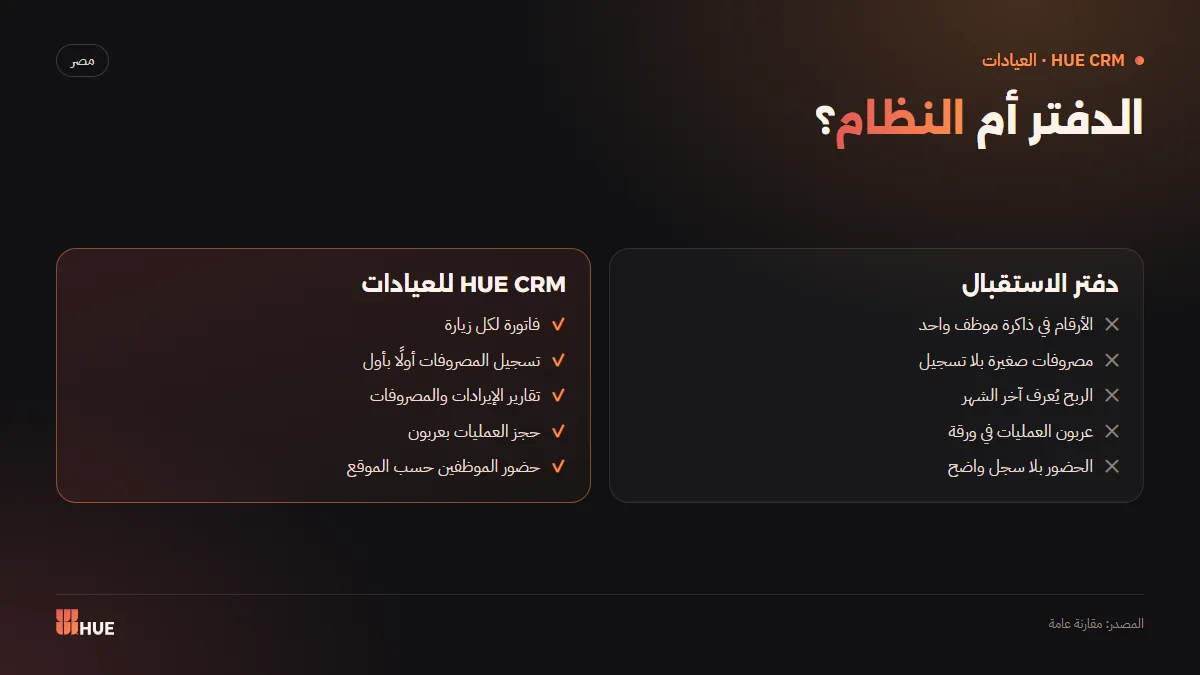
HUE CRM for Clinics supports staff attendance by location, and you can add a branch for EGP 199 a month and a user for EGP 39 a month as you grow. Multi-doctor medical centres are best served by the Medical Center plan at EGP 1,290 a month or EGP 11,990 a year.
Does clinic software replace an accountant?
No. Clinic software organises the daily recording of revenue and expenses and gives you clear operating reports, but it doesn't replace an accountant on accounting and legal matters. The real benefit is that your accountant gets organised, complete data instead of scattered papers, which makes their work faster and more accurate.
How do you read your clinic's month-end report?
Read it with three questions in turn: did revenue go up or down, why, and where did the expenses go? Don't stop at the total; compare it with the previous month and the same month last year if you have it, and look for the line that changed most. This simple reading catches most problems early.
- Revenue: compare with last month, then split by doctor or service.
- Visits and attendance rate: did revenue fall because there were fewer patients, or because no-shows rose?
- Expenses: rank lines from largest to smallest and look for one that jumped.
- Outstanding balances: who hasn't paid, and for how long?
- Decision: pick one action for next month, such as switching on reminders or reviewing the price of a service.
What are the common financial mistakes in small and mid-sized clinics?
The best-known mistakes are mixing clinic money with personal spending, relying on one employee's memory for collections, and not recording small expenses because they're "minor". Each is small on its own, but together they leave the owner working hard without knowing where the effort goes.
- Mixing clinic money with personal spending: separate them from day one.
- Relying on one person: if the receptionist is away, the numbers should still be in the system, not in their head.
- Ignoring small expenses: hospitality and daily supplies add up over a month.
- Pricing services without review: revisit prices regularly against your real costs.
- Leaving outstanding balances unchased: every late payment is tied-up cash.
Conclusion
Controlling clinic finances starts with a simple rule: an invoice for every visit, a category for every expense, a daily cash close, and five indicators reviewed weekly. In a market where patients usually pay out of pocket and competition is rising, these habits make the difference. To evaluate a full system, read the guide to choosing clinic management software in Egypt, and for the medical side of the file, see the guide to the electronic patient file and allergy alerts.
Sources
Questions
Which financial reports does a clinic owner need?
Revenue, expenses and outstanding patient balances, from which you calculate five weekly indicators: revenue per visit, attendance rate, revenue per doctor, outstanding balances and expense ratio.
How do I control cash collected at reception?
Issue an invoice for every visit, record each payment with its method, and close the cash drawer daily by matching actual cash against the system, signed off by the responsible person.
Should I take a deposit for surgery bookings?
A deposit protects theatre time and the team from sudden cancellations, as long as it is recorded against the surgery booking and the patient is followed up before and after.
How much is the surgeries module in HUE CRM?
The surgeries module is an add-on for EGP 199 on the Clinic plan and covers booking with a deposit, a prep checklist and post-operative follow-up.
How do I track staff attendance across branches?
Record check-in and check-out by location; in HUE CRM you can add a branch for EGP 199 a month and a user for EGP 39 a month as you grow.
Does clinic software replace an accountant?
No. It organises daily recording and gives you operating reports, while the accountant remains responsible for accounting and legal matters, working from better-organised data.