The electronic patient file and drug allergy alerts: a 2026 guide for clinics
The electronic patient file is where a doctor finds, in seconds, everything needed before writing a prescription: chronic conditions, allergies, current medications and vital-sign trends. A paper file can't warn you when you prescribe a drug the patient is allergic to. An electronic file can. That small difference can matter a great deal for patient safety.
Why is medication safety the biggest issue in a clinic?
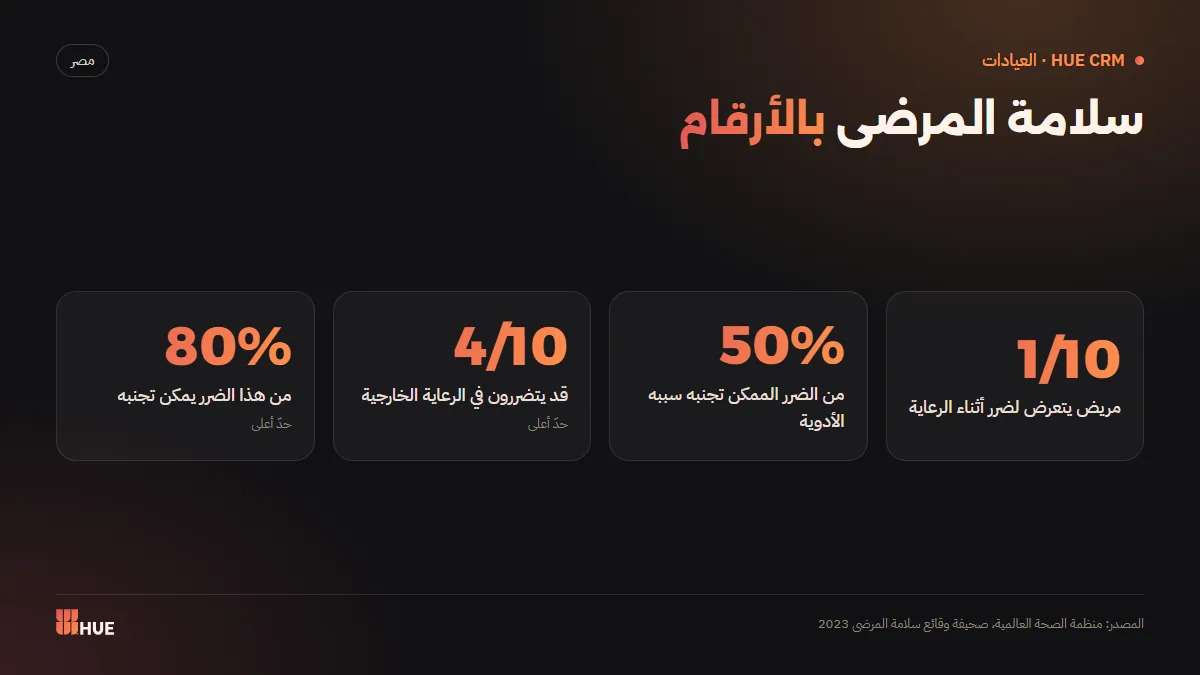
Because medications account for half of preventable harm in health care, according to the WHO. The organisation estimates that around 1 in 10 patients is harmed while receiving care, that harm in primary and outpatient care may affect up to 4 in 10 patients, and that up to 80% of it is avoidable.
The WHO also puts the global cost of medication errors at about US$42 billion a year, almost 1% of global health spending. It announced the figure when it launched the Medication Without Harm challenge in 2017 and repeated it for World Patient Safety Day 2022.
What does the data say about prescribing errors in Egypt?
Published Egyptian data is limited and fairly old, but it points the same way. In an analysis of about 12,000 medication-error reports to the national reporting system between June and December 2014, prescribing errors made up 54% of reported errors. In a review of 800 outpatient prescriptions, a missing diagnosis and missing patient details were the most common errors.
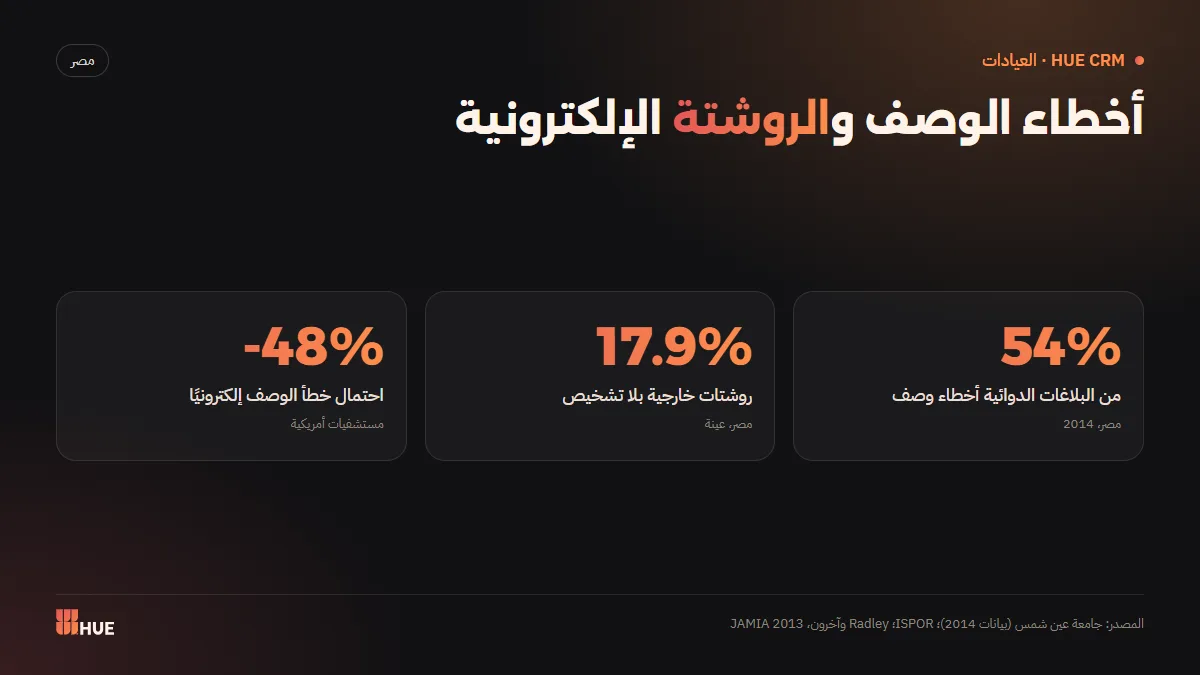
- 54% of reported medication errors were prescribing errors (national reporting system, 2014 data, Ain Shams University study).
- 17.9% of errors in 800 outpatient prescriptions were a missing diagnosis, and 14.8% missing patient details (research abstract published by ISPOR).
A methodological note: these are voluntary reports and specific samples, not national prevalence rates. They do show where the gaps are: missing information about the patient at the moment a drug is prescribed.
Does electronic prescribing reduce medication errors?
The evidence says it clearly helps. A 2013 meta-analysis of ten studies in JAMIA found that the likelihood of a prescribing error fell by about 48% when medication orders were entered electronically instead of on paper. The studies were in US hospitals, but the same idea applies in a clinic: legible orders and the patient's details in front of the doctor.
Why does this happen? An electronic prescription is always legible, pulls the patient's name and details from the file automatically, and puts allergies and chronic conditions in front of the doctor at the same moment.
What should an electronic patient file contain?
A good file answers three questions before every prescription: who is this patient, what must they not take, and how is their condition changing over time? So it needs basic details, allergies, chronic conditions, medications, vital signs, and the visit history with attachments.
| Section | What it contains | Why it matters to the doctor |
|---|---|---|
| Basic details | Name, age, contact details | Identify the patient accurately and reach them |
| Allergies | Drugs and substances they react to | Instant alert while prescribing |
| Chronic conditions | Diabetes, hypertension and others | Choose treatment that fits the condition |
| Current medications | What the patient is taking now | See the full medication picture |
| Vital signs | Blood pressure, pulse, sugar, weight | Track trends across visits |
| Visit history | Past diagnoses and prescriptions | Continuity of care between doctors |
How does a drug allergy alert work while prescribing?
Once an allergy is recorded in the patient file, the system checks it on every later prescription. If the doctor selects a drug recorded as one the patient is allergic to, an instant alert appears before the prescription is saved. The decision always stays with the doctor, but the information is never lost.
- The doctor or receptionist records the allergy in the patient file at the first visit.
- Allergies and chronic conditions appear at the top of the file at every visit.
- When a drug listed among the patient's allergies is prescribed, an instant alert appears.
- The doctor reviews the alert and chooses a suitable alternative.
- The prescription is saved to the patient's record so it shows at later visits.
That is what the patient file in HUE CRM for Clinics does: allergies and chronic conditions are always visible, with an instant alert when you prescribe a drug the patient is allergic to. You can see it in the interactive demo.
Why should the alert be precise and focused?
Because too many alerts weaken their effect. A scientific review of allergy decision-support systems notes that doctors may override up to 90% of allergy alerts because of "alert fatigue". A single clear alert tied to an actually recorded allergy works better, along with keeping the allergy list up to date and corrected.
For context only: in a US study of about 1.77 million patients, 35.5% had at least one drug allergy recorded in their file, with penicillin the most common at about 12.8%. This is US data, and recorded allergies usually run higher than confirmed ones, but it shows how often a doctor may need this information.
What is the difference between a paper file and an electronic file?
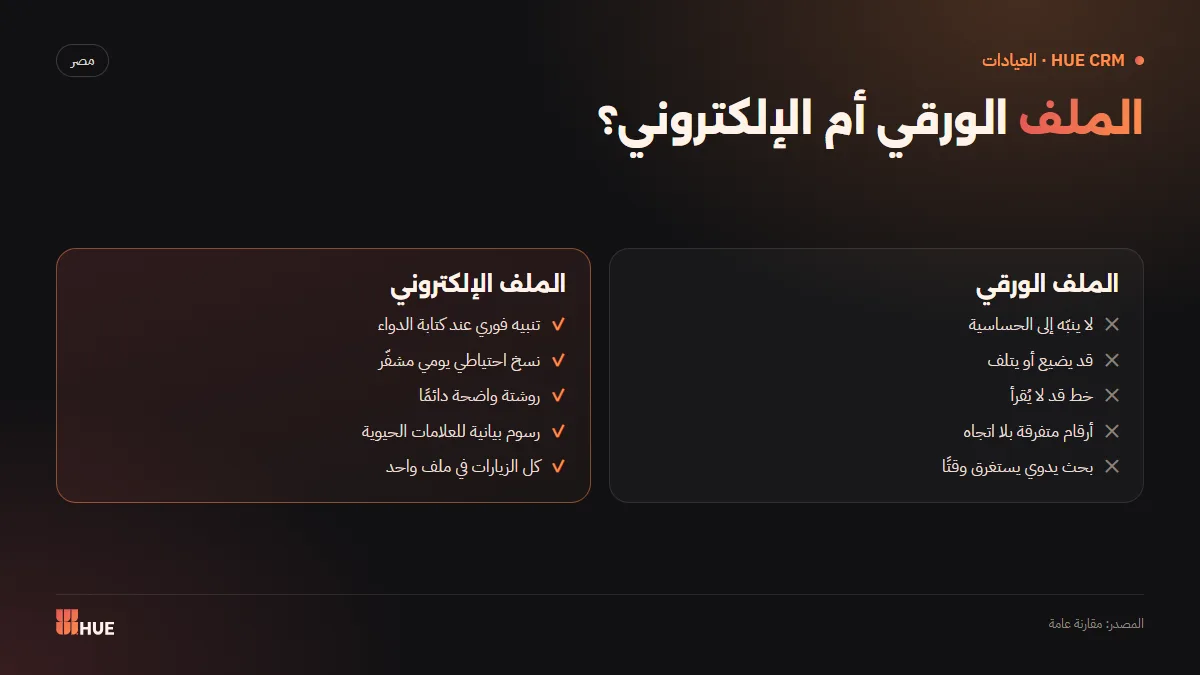
A paper file stores information but can't act on it: it doesn't alert, doesn't chart trends, and can be lost or damaged. An electronic file puts the information in front of the doctor at the right moment, is backed up, and can be searched in seconds.
How do you track a chronic patient's vital signs between visits?
Record the same readings at every visit in the patient file, then read them as a chart instead of scattered numbers. A chart shows at a glance whether a patient's blood pressure or sugar is improving or worsening with treatment, which makes decisions easier to take and to explain to the patient.
In HUE CRM, vital signs appear as charts inside the patient file, and a WhatsApp follow-up message goes to the patient after the visit to remind them of their follow-up appointment, as covered in our article on reducing no-shows.
Who may see the patient file, and how do you protect it?
The patient file is health data, which Egypt's Personal Data Protection Law No. 151 of 2020 classes as sensitive. Only people who need it for their work should reach it, and it should be protected with strong passwords, two-factor authentication and regular backups.
- Two-factor authentication at sign-in.
- A security log showing who signed in and when.
- Encrypted daily backups stored away from clinic hardware.
- Clear internal rules: no sharing passwords, no photographing files on personal phones.
HUE CRM for Clinics provides two-factor authentication, a security log and encrypted daily backups. For the rest of the selection criteria, see the guide to choosing clinic management software in Egypt.
How should you record patients' allergies correctly?
An alert is only as precise as the information behind it. Every patient should be asked about allergies at the first visit with a clear question, the allergy should be recorded by drug or substance name rather than a vague description, and the list should be reviewed at every visit. Accurate recording makes the alert useful; careless recording makes it noise.
- Ask every new patient: "Are you allergic to any medicine or substance?" and make it a fixed part of registration.
- Record the specific drug or substance, not a vague phrase like "allergic to antibiotics".
- Note the type of reaction if the patient knows it, such as a rash or shortness of breath.
- Distinguish true allergies from known side effects; mixing them up multiplies alerts for no reason.
- Review the list with the patient at each visit, adding anything new and correcting anything proven wrong.
What role does reception play in patient file safety?
The receptionist is the first person to open a patient's file, and accuracy with basic details makes a big difference: a patient registered twice means two incomplete files, and a wrong phone number means a reminder that never arrives. Training reception to register correctly is part of patient safety, not just admin.
- Search before creating: look the patient up by name or phone before opening a new file, to avoid duplicates.
- A correct phone number: confirmations, reminders and follow-ups go to it.
- Record declared allergies at first registration, then have the doctor review them.
- Update details at every visit if anything has changed.
Conclusion
The electronic patient file isn't just a digital archive; it's a safety tool. The WHO puts medications at the centre of preventable harm, and the evidence says electronic prescribing helps reduce errors. Start by recording allergies and chronic conditions for every patient, make the alert run on every prescription, and review vital signs as charts. This content is for general awareness; treatment decisions always rest with the doctor.
Sources
- World Health Organization — Patient safety fact sheet, 2023
- Health Policy Watch — World Patient Safety Day 2022: Medication Without Harm, 2022
- Ain Shams University — Medication errors reported to the Egyptian national system (2014 data)
- ISPOR — Medication prescribing errors in Egyptian community settings
- Radley et al. — Reduction in medication errors with computerized provider order entry, JAMIA 2013
- Zhou et al. — Drug allergies documented in electronic health records, 2016
- Scientific review — Drug allergy decision support and alert overrides
Questions
What belongs in an electronic patient file?
Basic details, allergies, chronic conditions, current medications, vital signs, and the history of visits, prescriptions and attachments.
How does a drug allergy alert work while prescribing?
The allergy is recorded once in the patient file; when a drug recorded as one the patient is allergic to is selected, an instant alert appears before the prescription is saved, and the decision stays with the doctor.
Does electronic prescribing reduce medication errors?
A 2013 JAMIA meta-analysis found prescribing errors were about 48% less likely with electronic ordering than with paper, in studies from US hospitals.
Does HUE CRM connect to a government e-prescription system or Universal Health Insurance?
No. Prescriptions are written and stored in the patient file inside the system, with no link to any government system.
How do I track a chronic patient's vital signs?
Record the same readings at every visit and read them as a chart in the patient file to see blood pressure or sugar trends across visits.
How do I protect patient data in my clinic?
Use a system with two-factor authentication, a security log and encrypted daily backups, and forbid password sharing, since health data is sensitive under Egypt's Law No. 151 of 2020.