CRM for Saudi Establishments and Factories: The Complete 2026 Guide
A CRM for establishments and factories is where every sales opportunity is recorded the moment it arrives, then followed step by step through installation and collection. Unlike a classic CRM, it keeps going after "deal won", into the workshop and the site, because in manufacturing and installation businesses the profit is made, or lost, after the customer signs.
In this guide:
- What a CRM for establishments and factories is, and its core parts
- Why Saudi businesses need one in 2026
- How it differs from accounting software and ERP
- The full customer journey from first message to collection
- How to choose, what it costs, and a two-week start plan
What is a CRM for establishments and factories?
It is a cloud system that keeps customer data and job stages in one record: from the lead, to the site visit and measurements, to the quotation and its approval, then the production order and installation, and finally warranty, maintenance and payment collection. The point is that nothing gets lost between a salesperson's phone, a technician's notebook and a spreadsheet.
In a small establishment, the owner is often the sales manager, production supervisor and collector at once. A light tool that understands their trade is enough: do they sell by linear metre, square metre or piece? Is a measurement visit needed before pricing? Does the order go through manufacturing before installation? Those questions are what separate a CRM for establishments and factories from a generic contact manager.
Why do Saudi businesses need a CRM in 2026?
Because the market is growing and competition is tightening. Saudi Arabia had about 1.86 million active commercial registrations at the end of Q4 2025 (Ministry of Commerce), and 12,946 existing factories in December 2025 (Ministry of Industry and Mineral Resources). In a market this size, the business that replies faster, delivers on time and collects without delay wins.
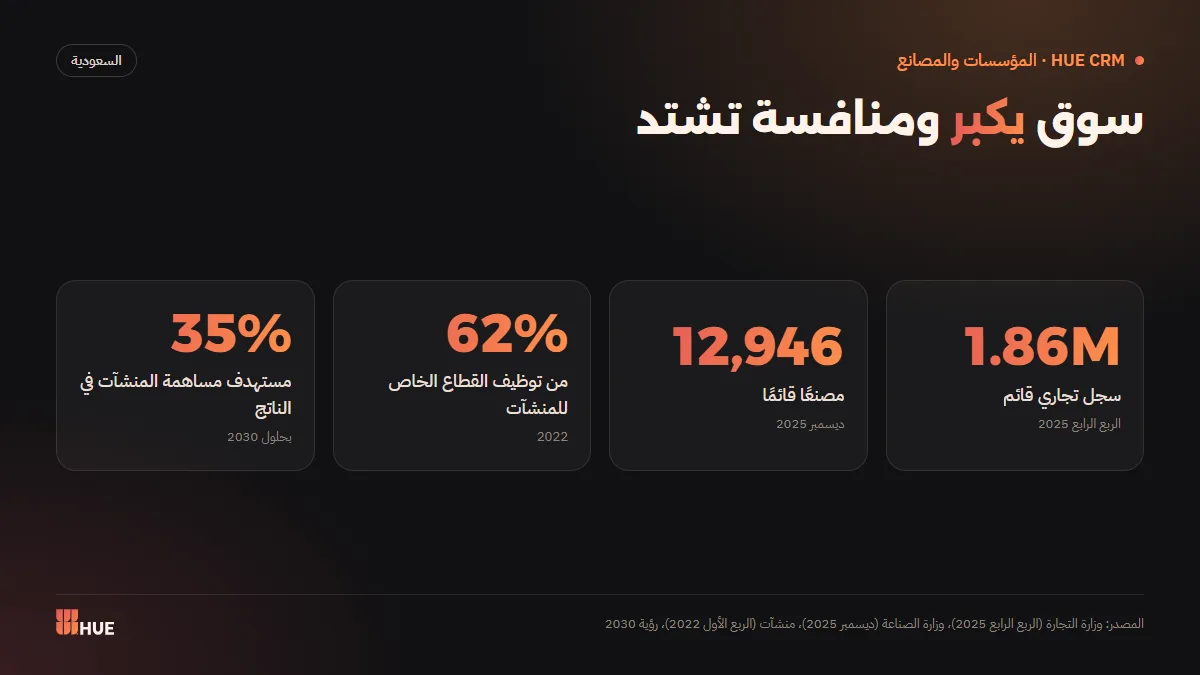
SMEs account for about 62% of private-sector employment according to Monsha'at's Q1 2022 report, and Vision 2030 targets raising their contribution to GDP to 35%, from 20% in 2016. Reaching that target takes businesses that run sales and operations digitally. We gathered these and other figures in Saudi establishments and factories in numbers, 2026.
How is a CRM different from accounting software and ERP?
Accounting software records what happened: an invoice issued, a payment received. A CRM tracks what is about to happen: a customer waiting for a reply, a quote not yet approved, an installation team due tomorrow. ERP is a broad system for large organisations covering finance, inventory and HR, and usually takes more time and budget to implement.
| Criterion | Accounting software | CRM for establishments & factories | ERP |
|---|---|---|---|
| Question it answers | What came in and went out? | Where is every customer and job? | How does the whole organisation run? |
| Main user | Accountant | Sales, technicians, management | Every department |
| Key outputs | Tax invoices, entries, financial reports | Quotes, site visits, production and installation orders | Enterprise-wide planning |
| Time to go live | Short | Short to medium | Usually long |
| Best for | Every business | SME establishments, workshops, factories | Large organisations |
A small business usually needs accounting software and a CRM that work together. That is why HUE CRM sends invoice drafts to the Saudi accounting tools Wafeq, Daftra and Qoyod, which issue the ZATCA-compliant e-invoice. HUE CRM itself does not issue tax invoices.
What does the customer journey look like inside the system?
The journey in manufacturing and installation is longer than in a shop, and every stage is a possible weak point. A good system turns it into clear stages, each with an owner, a date and a ready WhatsApp message for the customer.
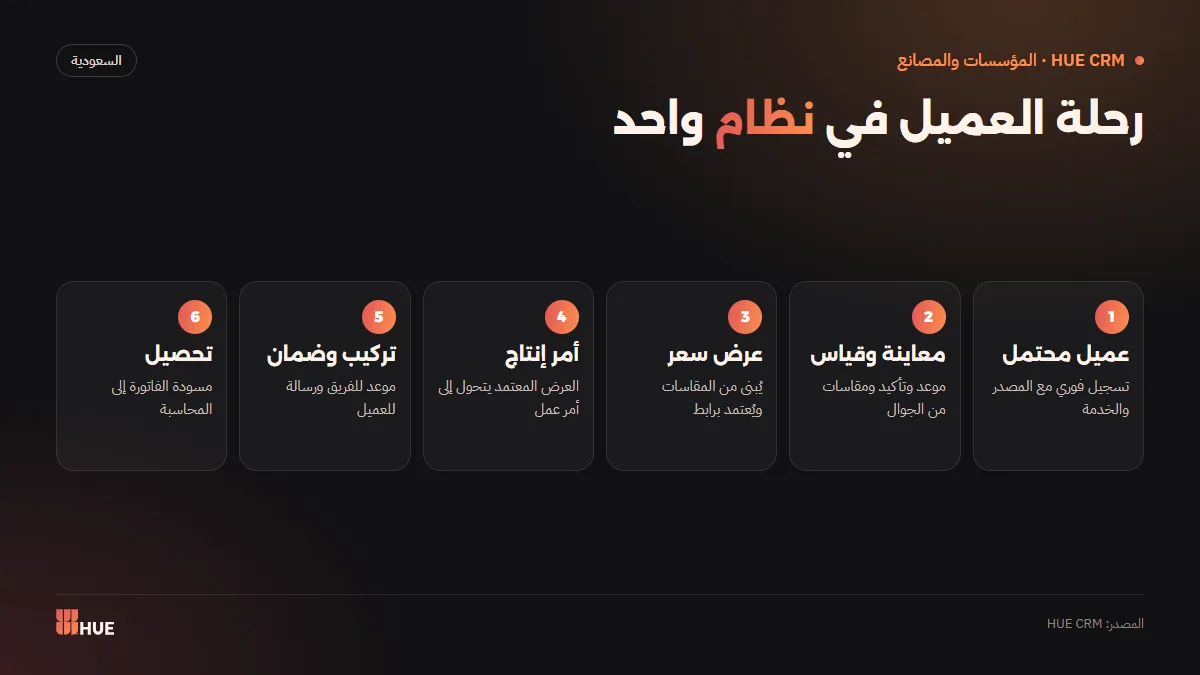
- Lead: the message or call is logged at once with its source and the service requested.
- Site visit and measurement: the visit is booked, the customer gets a confirmation, and the technician records measurements and notes from their phone.
- Quotation: the quote is built from the recorded measurements, in the right unit for your trade.
- Online approval: the customer gets a link to review and approve the quote, ending the back-and-forth lost in chats.
- Production order: the approved quote becomes a work order for the relevant section.
- Installation: the team is scheduled and the customer is told the date.
- Warranty and maintenance: project data stays on file for any later visit.
- Collection: outstanding payments are tracked, and the invoice draft goes to your accounting software.
If you work in aluminium, kitchens or curtains, this journey is walked through with practical examples in From measurement to installation.
How does HUE CRM adapt to your trade?
When you sign up you pick your activity from 42 activities in 5 groups, and the system adapts automatically. The basic configuration for each activity is ready from day one, so you need no developer and no weeks of setup.
What changes by activity?
- Units of measure: linear metre, square metre, piece and others, linked to the unit codes used in ZATCA e-invoicing
- Measurement fields: what a technician records on site differs between an aluminium window, a kitchen, a curtain and a shade
- Sections: the internal work sections an order passes through
- Statuses: order stages named the way your team and customers understand them
- WhatsApp messages: ready texts for each stage, worded for your trade
Available activities include aluminium and uPVC, kitchens, shades and pergolas, gypsum and decor, air conditioning, CCTV, solar, signage, curtains, building materials and contracting.
Which everyday problems does it solve?
Most of what establishments lose comes from small, repeated gaps: an unanswered message, a measurement written on paper and lost, a quote sent and forgotten, a final payment nobody chased.
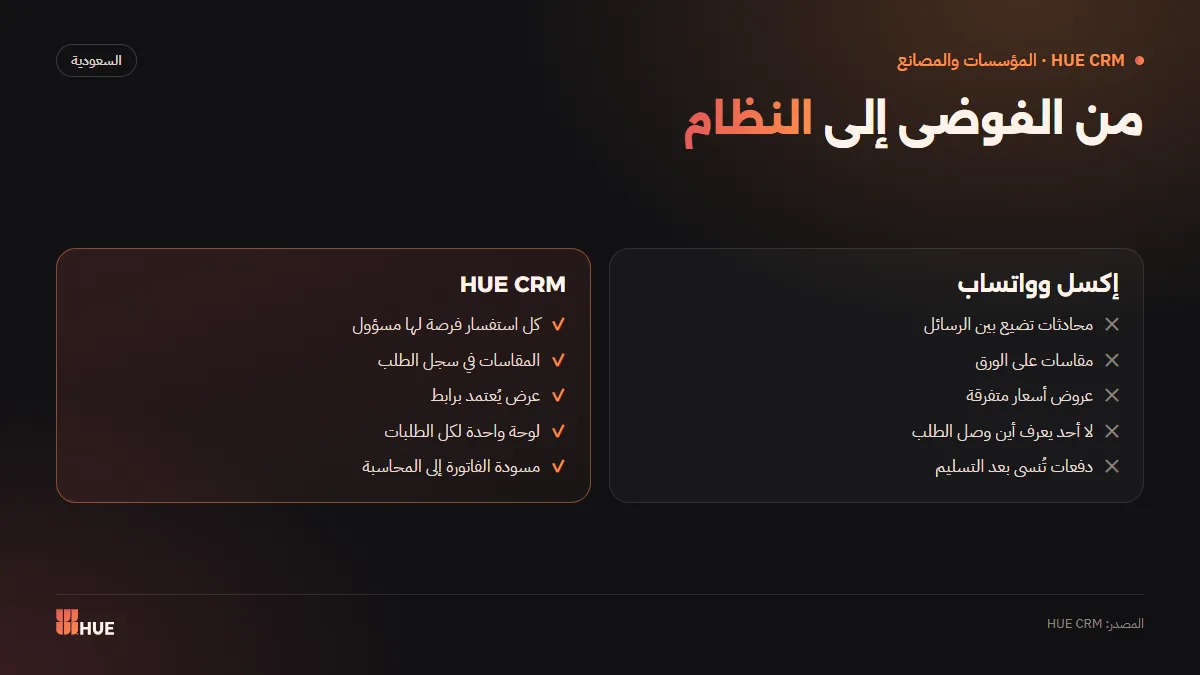
- Leads lost in WhatsApp: every chat becomes a logged opportunity with a stage and an owner. See WhatsApp sales follow-up
- Manual quotes: quotes are built from measurements and approved by link instead of scattered files
- No view of the team: management sees on one board where every order is and who owns it
- Late collection: amounts due are visible and drafts go to accounting. More in The quote approved in one tap
How do you choose the right CRM for your business?
Start from your problems, not from feature lists. Write down the three issues costing you money today and test each system on exactly those during the trial.
- Trade fit: does it know your units and stages, or will you build them from scratch?
- Language: a full right-to-left Arabic interface, not a partial translation.
- Mobile: can technicians and salespeople work from their phones on site without a complicated install?
- WhatsApp: are there ready messages for each stage?
- Accounting integration: does it connect to the accounting tool you use?
- Clear tax boundaries: be wary of any non-accounting system claiming you no longer need e-invoicing software.
- Try before paying: a free trial long enough to run a real job end to end.
How much does HUE CRM for establishments cost?
The base plan starts at SAR 95 a month excluding 15% VAT, with a 14-day free trial and a 30-day money-back guarantee.
| Item | Details |
|---|---|
| Base plan | SAR 95/month + 15% VAT |
| Included | 1 brand/branch, 3 products per brand, 5 users |
| Extra brand or branch | SAR 69/month |
| Extra product | SAR 50/month per brand |
| Extra user | SAR 20/month |
| Term discount | 10% for 3 months, 15% for 6 months, 20% for a year |
| Setup service (optional) | SAR 299, free on yearly plans |
| Trial and guarantee | 14 days free, 30-day money-back |
Current details are always on the pricing section.
How do you get started in two weeks?
The 14-day free trial is enough to run the system on real jobs if you follow a simple plan.
- Day 1: sign up, choose your activity, and review the ready stages and units.
- Day 2: add your team (up to 5 users on the base plan) and set permissions.
- Days 3 to 7: log every new customer in the system as they arrive; do not keep a parallel spreadsheet.
- Days 8 to 12: send quotes with approval links and track production and installation in the system.
- Days 13 and 14: review the dashboard: how many leads, how many approved quotes, which jobs are late. Then decide.
Summary
A CRM for establishments and factories closes the gaps where profit leaks between the first message and the last payment. Choose one that understands your trade, works on mobile, sends WhatsApp messages at every stage and integrates with your accounting software instead of pretending to replace it. Then test it on real jobs before committing.
Sources
- Ministry of Commerce via Mubasher: Existing commercial registrations surpass 1.8 million in Q4 2025, 2026
- Ministry of Industry and Mineral Resources via Arab News: 2025 industrial indicators, 2026
- Monsha'at via Arab News: SMEs at 62% of private-sector employment, 2022
- Arab News: Monsha'at aims to raise SME GDP contribution to 35%, 2024
- Alraedah Finance: Annual Report 2023 (20% baseline in 2016), 2023
- ZATCA: E-invoicing
Questions
What is the difference between a CRM and accounting software?
Accounting software records invoices and payments after they happen; a CRM tracks customers and jobs before and after the sale, through installation and collection. They work best together.
Does a small establishment need a CRM?
Yes, if it receives requests over WhatsApp and phone and its jobs pass through stages such as site visits, manufacturing and installation. Any stage without organised follow-up can lose a lead or a payment.
Does HUE CRM issue ZATCA-compliant e-invoices?
No, the system does not issue tax invoices. It sends an invoice draft to your accounting software (Wafeq, Daftra or Qoyod), which issues the e-invoice.
Does it work on mobile?
Yes. It runs in the phone browser with an Arabic interface and can be added to the home screen as a web app, so technicians and salespeople can use it on site.
How much does HUE CRM for establishments cost?
The base plan starts at SAR 95 a month excluding 15% VAT and includes one branch and 5 users, with a 14-day free trial and a 30-day money-back guarantee.
How long does it take to get started?
You can start the same day, because the system adapts to the activity you pick from 42. An optional setup service costs SAR 299 and is free on yearly plans.