WhatsApp Customer Follow-Up: A Step-by-Step Sales System with Ready Templates (2026)
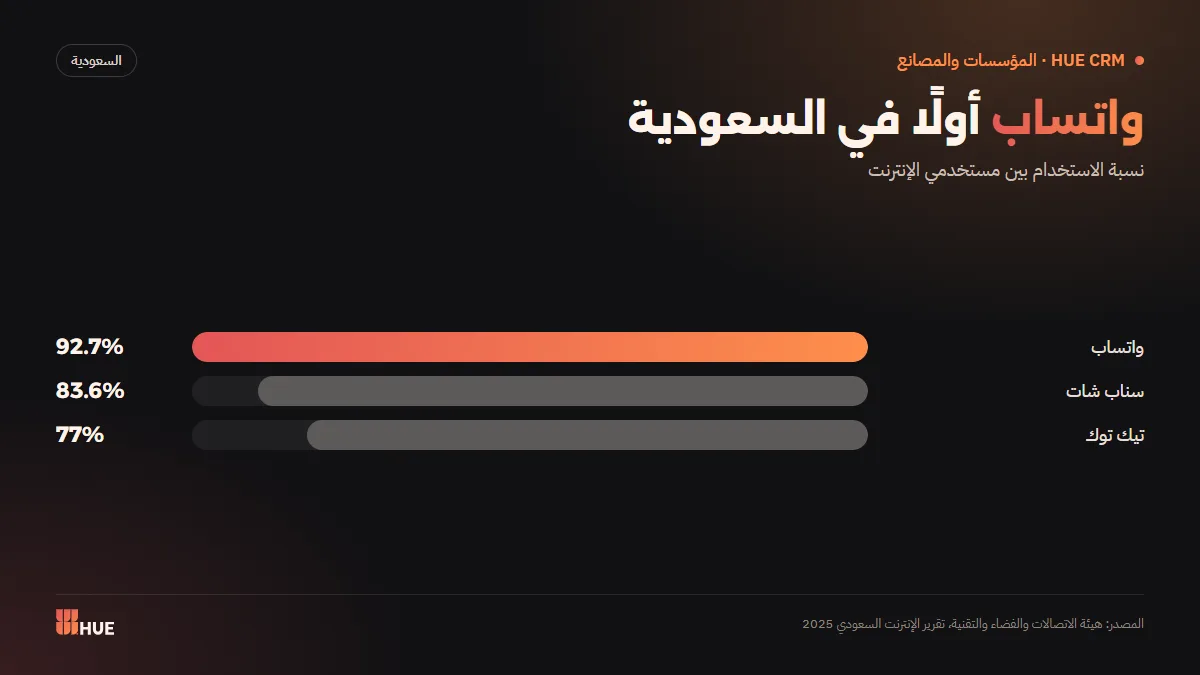
WhatsApp is the most used social platform in Saudi Arabia, with a 92.7% usage rate according to the Saudi Internet Report 2025 from the Communications, Space and Technology Commission (CST). That is where most customers reach establishments first. But a chat is not a sales system: unless every conversation is logged and followed with a stage, an owner and a date, opportunities get lost between messages.
This guide is practical. It explains why customers get lost on WhatsApp, how to build a follow-up system step by step, and gives ready message templates for every stage from enquiry to collection.
Why do customers get lost in WhatsApp chats?
Customers get lost because a chat has no status, no date and no owner. The message sinks under dozens of newer ones, every employee assumes a colleague replied, and the manager has no idea how many enquiries arrived this week or how many became quotes.
- Messages get buried: an enquiry not answered today disappears under other chats tomorrow
- Personal phones: when an employee leaves, their chats and customers leave too
- No stage: nobody knows whether the customer is waiting for a visit, a quote or a decision
- Inconsistent replies: everyone writes in their own style and some replies miss key information
- No numbers: reply speed and conversion cannot be measured
How much does reply speed matter for a new lead?
Reply speed is one of the strongest factors in turning an enquiry into a serious opportunity. In a US study published in Harvard Business Review in 2011, companies that contacted a lead within an hour were about 7 times more likely to have a meaningful conversation with a decision maker than those that waited one more hour.
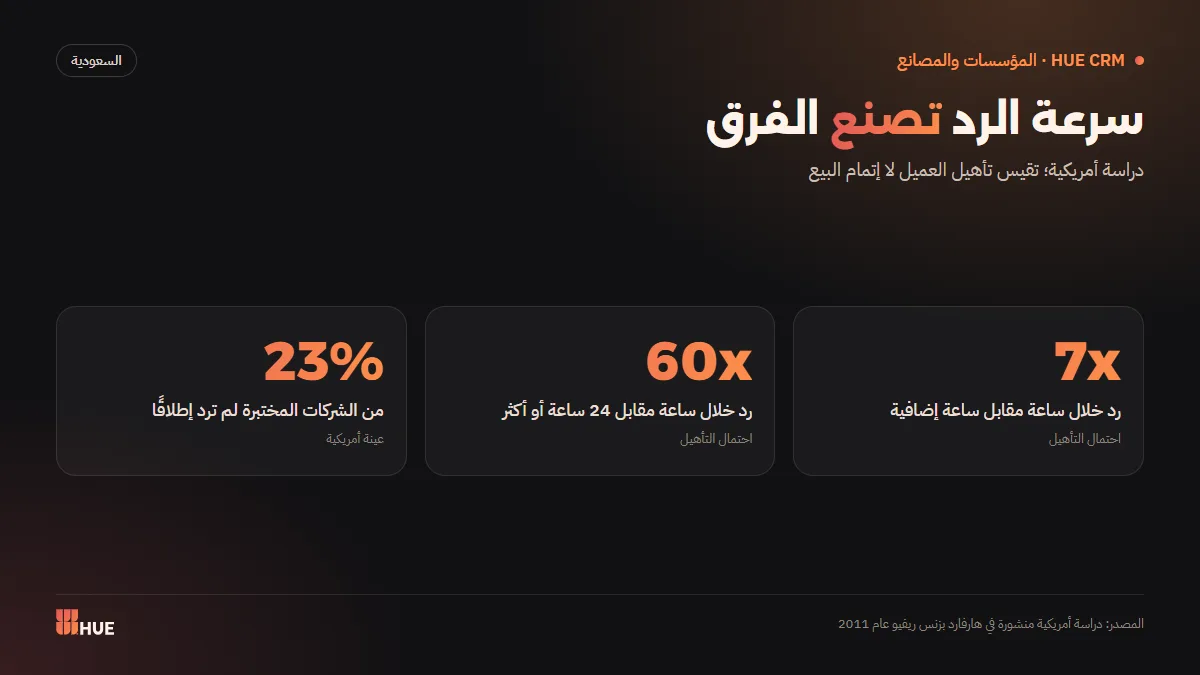
In the same research, companies replying within an hour were more than 60 times as likely to qualify the lead as those waiting 24 hours or longer, while 23% of the companies audited never replied at all. An important caveat: the study covered US companies and measures "qualification", meaning a meaningful conversation with a decision maker, not a closed sale. Still, it confirms a general principle: the customer asking you today may ask your competitor tomorrow.
How do you build a WhatsApp sales follow-up system?
A working system rests on one simple rule: every new chat immediately becomes a CRM record with a stage, an owner and a next follow-up date. Ready messages for each stage then keep replies fast and consistent.
- Log every enquiry immediately with the customer's name, number, service type and source.
- Assign one owner per opportunity, so two people never reply and nobody ignores it.
- Set a clear stage: enquiry, site visit, quote, approval or execution.
- Set the next follow-up date before leaving the chat.
- Use a ready message for the stage, then add a personal touch.
- Check the board daily: who has not been answered, whose follow-up is late?
HUE CRM comes with ready WhatsApp messages for each stage, worded for the activity you pick from 42, so an aluminium workshop's message differs from an air-conditioning or curtain company's. For the rest of the system, see the complete guide to CRM for establishments and factories.
Which ready messages work at each sales stage?
Each stage has one goal, and a good message serves it in two or three sentences. The templates below are illustrative examples; adapt them to your company's tone.
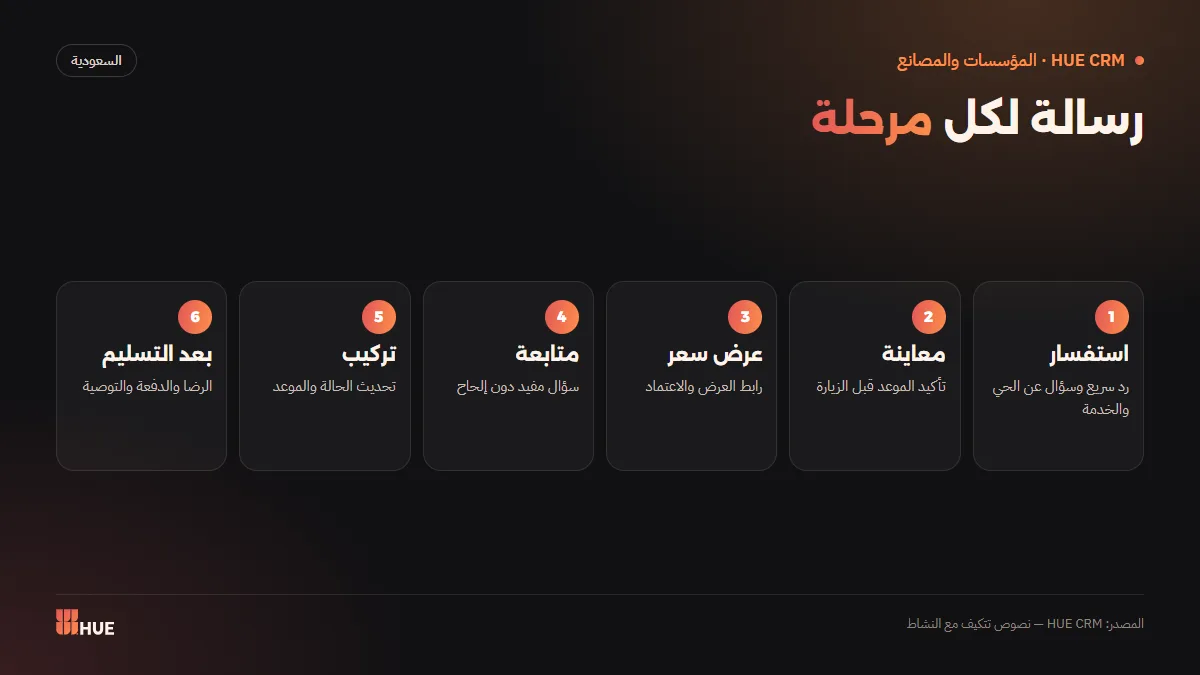
| Stage | Message goal | Illustrative template |
|---|---|---|
| Enquiry | Reply fast and collect details | "Welcome, and thank you for contacting us. Could you share your district and the service you need so we can book a measurement visit?" |
| Visit booking | Confirm and reduce no-shows | "We confirm your measurement visit on Tuesday afternoon. The technician will call before arriving." |
| Quote | Make approval easy | "We have sent your quote via the attached link; you can approve it directly from there." |
| Quote follow-up | Move the decision without pressure | "Just checking whether you have reviewed the quote. Happy to answer any questions." |
| Production & installation | Keep the customer informed | "Manufacturing of your order has started; we will confirm the installation date as soon as it is ready." |
| After handover | Satisfaction, payment, referral | "Installation is complete. We welcome your feedback, and a reminder of the remaining instalment under the approved quote." |
Collection in particular needs careful wording; we cover it in The quote approved in one tap.
When should you follow up after sending a quote?
The days after a quote is sent are the most sensitive, as many customers compare offers early on. The practical rule: set the first follow-up date when you send the quote, make the follow-up a useful question rather than pressure, and log the outcome in the system.
- Ask for feedback on items or measurements, not just "have you decided?"
- Offer to clarify an unclear item or suggest an alternative material
- Mention the quote's validity period if there is one
- If the customer declines, log the reason; it is valuable for future quotes
Does your business need the WhatsApp Business API?
Not necessarily at first. The WhatsApp Business app is usually enough for small teams, as long as chats are logged and followed in a CRM. The WhatsApp Business API suits larger teams that need broad automation and automatic chat routing, and it requires extra setup and cost.
What matters is discipline, not the tool: an owner per opportunity, a stage per customer, a date per follow-up. A BCG report cited by Meta found that 84% of institutions in Saudi Arabia plan to invest in rich messaging technologies over the next five years, so competition on this channel will grow.
How do you write a professional WhatsApp message to customers?
A professional message is short, clear and ends with one specific next step. Customers read it on their phone among dozens of others; if they cannot tell what you need within seconds, they postpone, and in sales postponing is where losing starts.
- Open with a greeting and the name if known; personal messages get read first
- State the purpose in the first line: a visit confirmation, a quote or an order update
- End with one question or one step: "Does Tuesday suit you?" beats an open paragraph
- Use text, not voice, for important details such as dates and prices
- Keep one consistent tone across staff so the customer feels they deal with a company, not individuals
- Respect the customer's time and avoid late-night follow-ups
How do you handle a customer who does not reply?
Silence does not always mean no: the customer may be busy, comparing offers or waiting for someone else's approval. What matters is a clear, limited follow-up sequence, neither random chasing nor giving up too early.
- First follow-up: a useful question about the quote or measurements on the date you set when sending it.
- Second follow-up: new, valuable information, such as clarifying an item or suggesting an alternative material.
- Third follow-up: a polite message asking whether the project is still on, leaving the door open.
- Close the opportunity: if there is still no reply, close it in the system with the reason "no reply", and reach out later if appropriate.
What are the common WhatsApp follow-up mistakes?
- Sending the quote as a file with no message explaining the next step
- Long voice notes instead of clear text the customer can refer back to
- Daily nagging with nothing new to offer
- Relying on an employee's memory instead of a logged date
- Closing an opportunity without recording why it was lost
How do you turn a happy customer into a source of new ones?
The best new customer arrives on a past customer's recommendation: they come trusting you and less focused on comparing prices. But referrals do not happen by themselves; they need a message at the right moment, a few days after installation, when satisfaction is highest.
- Ask for feedback after handover and thank the customer whatever they say
- If they are happy, politely ask them to recommend you to anyone needing similar work
- Log the source of every new customer in the system to see how many came by referral
- Get in touch at the periodic maintenance date if your trade needs one
How do you measure WhatsApp follow-up success?
What is not measured does not improve. Pick four simple metrics and review them weekly on the system dashboard. The table explains each one; your targets depend on your trade.
| Metric | What it measures | How to read it |
|---|---|---|
| First reply time | Speed of response to enquiries | Shorter means better qualification odds |
| Enquiry-to-visit rate | Quality of the first reply | A drop means weak replies or poor-fit leads |
| Quote approval rate | Strength of quote and follow-up | A drop calls for reviewing pricing or follow-up |
| Overdue opportunities | Team discipline | Anything past its follow-up date needs action |
Summary
WhatsApp is where your customers start, but on its own it cannot run your sales. Turn every chat into a logged opportunity, reply within the first hour, use a ready message for each stage and measure results weekly. If your trade involves measurement and installation, see this journey applied in From measurement to installation.
Sources
Questions
Do I need the WhatsApp Business API to follow up customers?
Not necessarily at first. The WhatsApp Business app is usually enough for small teams if chats are logged and followed in a CRM; the API suits larger teams that need broad automation.
When should I reply to a new lead?
As fast as possible, ideally within the first hour. In a US study published in Harvard Business Review in 2011, replying within an hour made qualifying the lead about 7 times more likely than waiting one more hour.
How do I stop leads getting lost between salespeople?
Log every enquiry in the system as it arrives, give it one owner, a stage and a follow-up date, and review the overdue opportunities board daily.
When should I follow up after sending a quote?
Set the first follow-up date when you send the quote, make it a useful question about the customer's feedback on items or measurements, and log the outcome in the system.
Are ready-made messages annoying for customers?
Not if they are short and tied to a real stage, such as confirming a visit, sending a quote or sharing an installation date. In HUE CRM the texts adapt to your trade.