Reducing patient no-shows: WhatsApp reminders, by the numbers
Every appointment a patient misses is paid doctor time with no revenue, and a slot another patient could have used. Global figures suggest roughly one appointment in four can be lost, and a simple reminder before the visit clearly lifts attendance. This article sets out the numbers, works out the loss with an illustrative example, and lays out a practical messaging plan.
What is the average patient no-show rate?
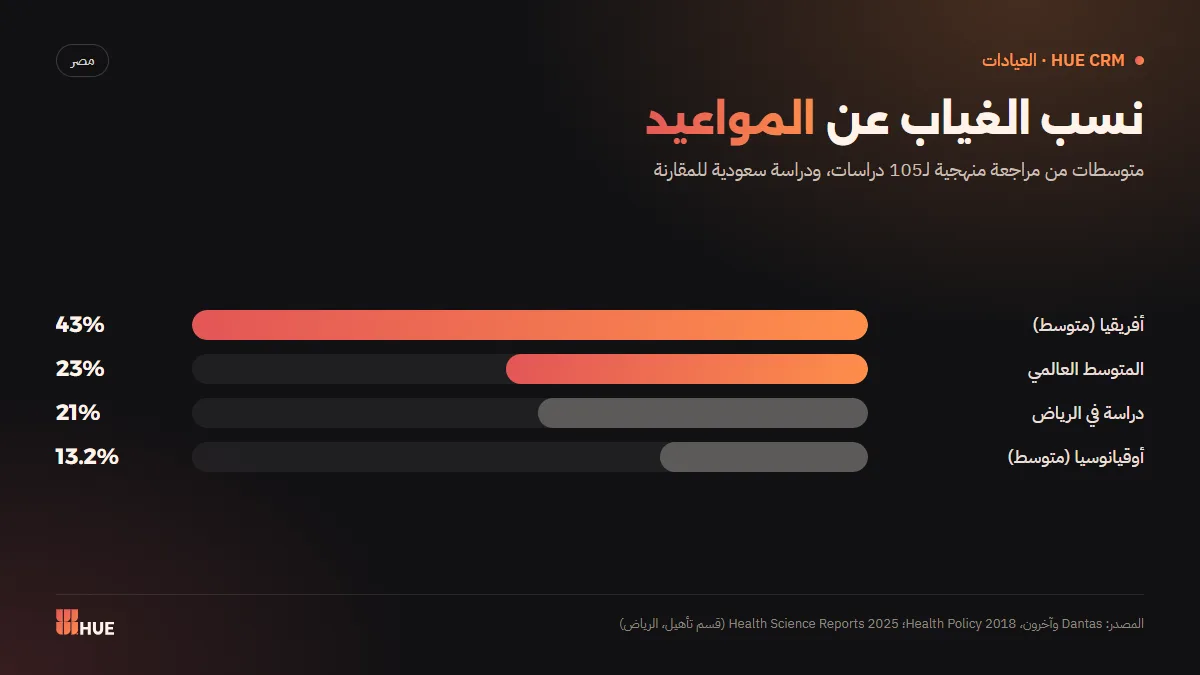
The global average is about 23%, according to a 2018 systematic review in Health Policy that analysed 105 studies. Rates vary widely by region: the highest in African studies at about 43%, the lowest in Oceania at about 13.2%. There is no reliable published national no-show rate for Egypt yet.
These are global and regional averages, not a measurement of any particular clinic, but they show the scale of the problem. Closer to home, a 2025 study in a rehabilitation department at King Abdulaziz Medical City in Riyadh found that 21% of appointments were missed, and noted that Saudi studies report rates between 11% and 30% depending on the setting and service.
Why do patients miss appointments?
The two strongest predictors in the systematic review were the lead time between booking and the appointment and the patient's history of missed visits. No-shows were also linked to younger age, lower income, living far from the clinic and having no private insurance. Many of these can be addressed with reminders and easy rescheduling.
| Cause | What helps reduce it |
|---|---|
| Forgetting, especially with long lead times | A reminder the day before |
| The booking was never confirmed | An instant confirmation message |
| Hard to cancel or reschedule | A clear way to get in touch and change the slot |
| A patient who habitually misses visits | Tracking their record and applying clear rules |
| Distance and traffic | Location and time in the message itself |
Do reminder messages actually reduce no-shows?
Yes, according to the best available evidence. A 2013 Cochrane systematic review found that text reminders increased attendance compared with no reminder, with a risk ratio of 1.14 across 7 trials and 5,841 participants, or about 14%. It also found text reminders worked as well as phone calls, at a lower cost per attendance.
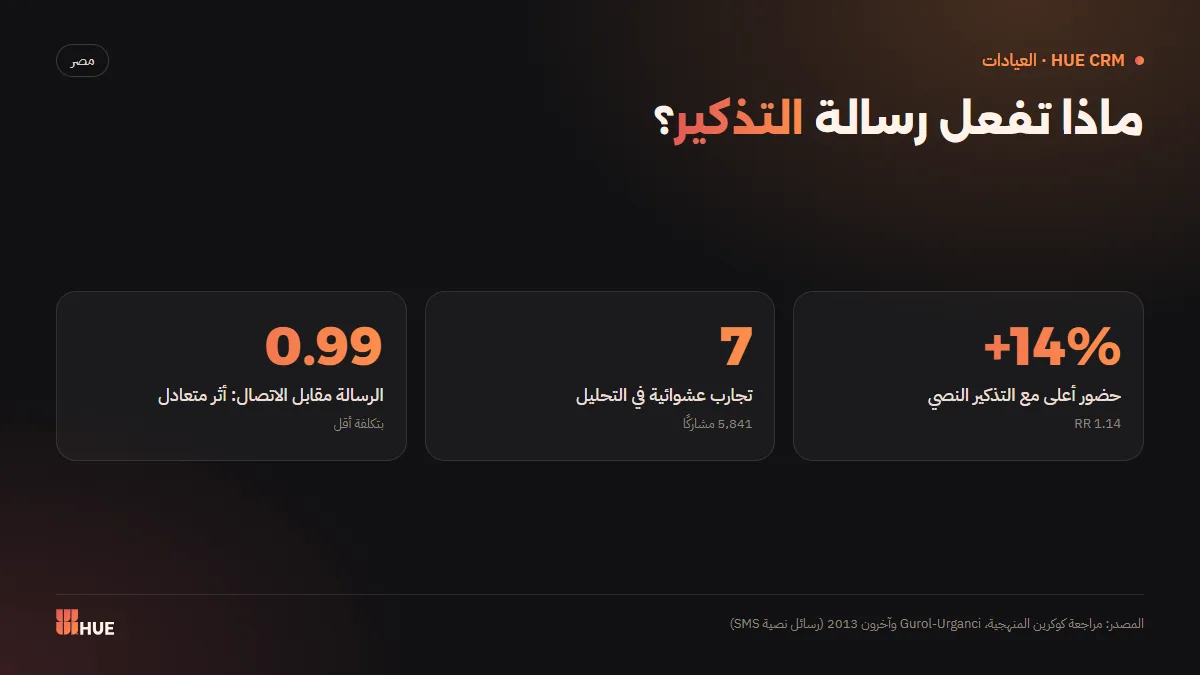
To be precise: those trials studied SMS, and there is no published randomised trial of WhatsApp specifically yet. The mechanism is the same, though: reaching the patient on their phone at the right time. In Egypt, DataReportal counts 121 million mobile connections at the end of 2025, 95.4% of them broadband (3G/4G/5G), so patients are widely reachable on their phones.
Claims on some marketing sites that WhatsApp "cuts no-shows by 70%" have no published study behind them, so we don't use them here.
How much do no-shows cost your clinic each month? (illustrative example)
The loss equals missed appointments multiplied by the consultation fee and the number of working days. The table below is an illustrative example with hypothetical figures for a mid-sized clinic, not market data. The point is to apply the same formula to your own numbers.
| Item | Hypothetical value |
|---|---|
| Daily bookings | 20 |
| Hypothetical no-show rate | 20% (below the 23% global average) |
| Missed appointments per day | 4 |
| Hypothetical consultation fee | EGP 300 |
| Working days per month | 24 |
| Revenue lost per month | EGP 28,800 |
With these hypothetical numbers, recovering just one of the four missed appointments a day through confirmations and reminders would mean EGP 7,200 a month, several times the HUE CRM Clinic plan (EGP 449 a month). Replace the hypothetical figures with your clinic's real ones to see your own loss.
What is the ideal WhatsApp messaging plan to reduce no-shows?
An effective plan is four messages at set moments: an instant confirmation after booking, a reminder the day before, a follow-up after the visit and a review request. The aim isn't to flood the patient, but to send what they need at the right moment, with an easy way to reschedule.
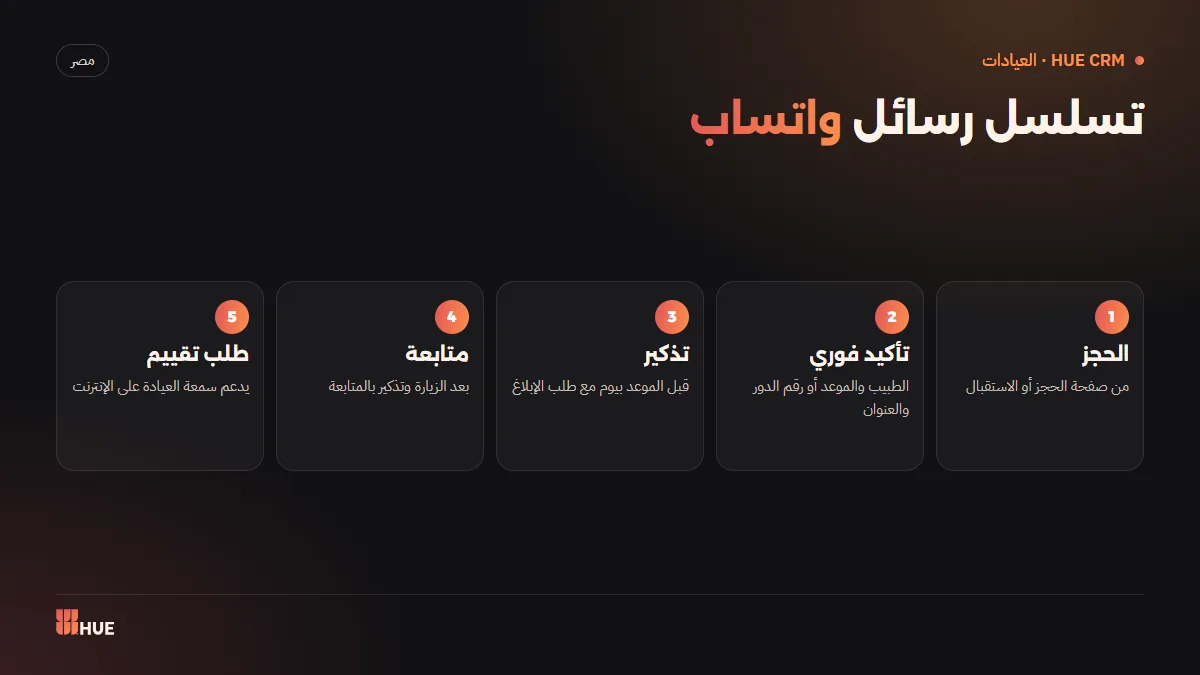
- Booking confirmation as soon as it is made: name, doctor, day and time or queue number, and address.
- A reminder the day before: repeats the details and asks the patient to get in touch if they can't come, so the slot can go to someone else.
- A follow-up after the visit: checks on the patient and reminds them of any follow-up appointment.
- A review request: after a good visit, it helps build the clinic's online reputation.
HUE CRM for Clinics sends all four automatically. There is an optional one-time service for an official WhatsApp Business link-up at EGP 2,000, or EGP 2,500 together with onboarding and training. Details are on the pricing section.
Is timed booking better than queue booking for reducing no-shows?
There's no single answer for every clinic. Timed appointments reduce waiting and suit clinics with regular consultation lengths, while queue booking suits clinics where visit length varies a lot. Whichever you use, tie it to confirmations and reminders, and let patients see what is really available.
| Timed appointments | Queue booking |
|---|---|
| The patient picks from real free slots | The patient takes a number in the day's queue |
| Less waiting inside the clinic | More flexibility when visit lengths vary |
| Suits regular consultations and follow-ups | Suits busy clinics with mixed cases |
HUE CRM supports both: the online booking page shows real free slots so patients choose their own time, or they book by queue. For organising the waiting room, see the waiting room and online booking guide.
How should you handle patients who repeatedly miss appointments?
Set a clear, stated rule instead of case-by-case decisions: record every no-show in the patient file, contact the patient after the first one to find out why, and ask for an extra confirmation before their next appointments. The goal is to keep both the patient and the clinic's time, not to punish anyone.
- Record no-shows in the patient file so they show up at the next booking.
- Send a polite follow-up after a no-show asking why and offering another slot.
- Ask repeat no-shows to confirm by replying to the reminder.
- Give them nearer dates rather than distant ones, since long lead times are among the strongest causes of no-shows.
What should a good reminder message include?
A good message is short and clear and answers everything the patient needs without calling the clinic: which doctor, when the appointment is or what the queue number is, where the clinic is, and what to do if they can't come. Every extra line lowers the chance it gets read, and every missing detail means another call to reception.
- Patient and doctor names: so the message feels personal and trustworthy.
- Day and time, or queue number: written so it can't be misread.
- Address or a landmark: especially for new patients.
- A clear request if they can't come: "If you can't make it, please let us know so we can offer the slot to another patient."
- What to bring: such as previous tests or scans, if needed.
- Polite, brief wording: no pile of links or repeated messages.
How do you measure your clinic's no-show rate?
It's simple when appointments live in a system: divide the appointments patients neither attended nor cancelled by the total booked in the same period. Measure a full month before switching on reminders and a month after, so you see the effect in your own clinic, not just in studies.
- Record every booking in the system, including phone bookings and walk-ins.
- Separate advance cancellations from unannounced no-shows; the first can be refilled, the second can't.
- Calculate the rate monthly, and per doctor if possible.
- Compare the month before reminders with the month after.
- Watch the days and hours with the most no-shows and adjust the schedule accordingly.
Conclusion
No-shows are common worldwide, averaging about 23%, and their cost to a clinic is real even when it never appears in the books. The best available evidence says reminders lift attendance, and a simple plan is enough: instant confirmation, a day-before reminder, a follow-up and a review request, with your no-show rate measured every month. For the full picture on choosing a system, read the guide to choosing clinic management software in Egypt.
Sources
- Dantas et al. — No-shows in appointment scheduling: a systematic literature review, Health Policy 2018
- Health Science Reports — Reasons for no-shows in a rehabilitation department, King Abdulaziz Medical City, 2025
- Cochrane — Mobile phone messaging reminders for attendance at healthcare appointments, 2013
- DataReportal — Digital 2026: Egypt, 2025
Questions
What is the average patient no-show rate?
The global average is about 23% according to a 2018 systematic review of 105 studies, rising to about 43% in African studies. There is no published national rate for Egypt yet.
When should I send the reminder?
Send a confirmation as soon as the booking is made, then a reminder the day before so the patient can cancel early and the slot can go to someone else.
Are reminder messages better than phone calls?
A 2013 Cochrane review found text reminders lift attendance as much as phone calls at a lower cost per attendance, and they save receptionist time.
Are there studies on WhatsApp reminders specifically?
Published trials studied SMS; we found no published randomised trial of WhatsApp specifically, though the mechanism of reaching the patient's phone is the same.
Is queue booking better than timed appointments?
It depends on the clinic: timed slots reduce waiting, while queues suit varying visit lengths. HUE CRM supports both, with confirmations and reminders.
How should I handle patients who keep missing appointments?
Record no-shows in their file, contact them to find out why, ask them to confirm by replying to the reminder, and offer them nearer dates.