Meta commercial terms now Nov 20: what to check on your site
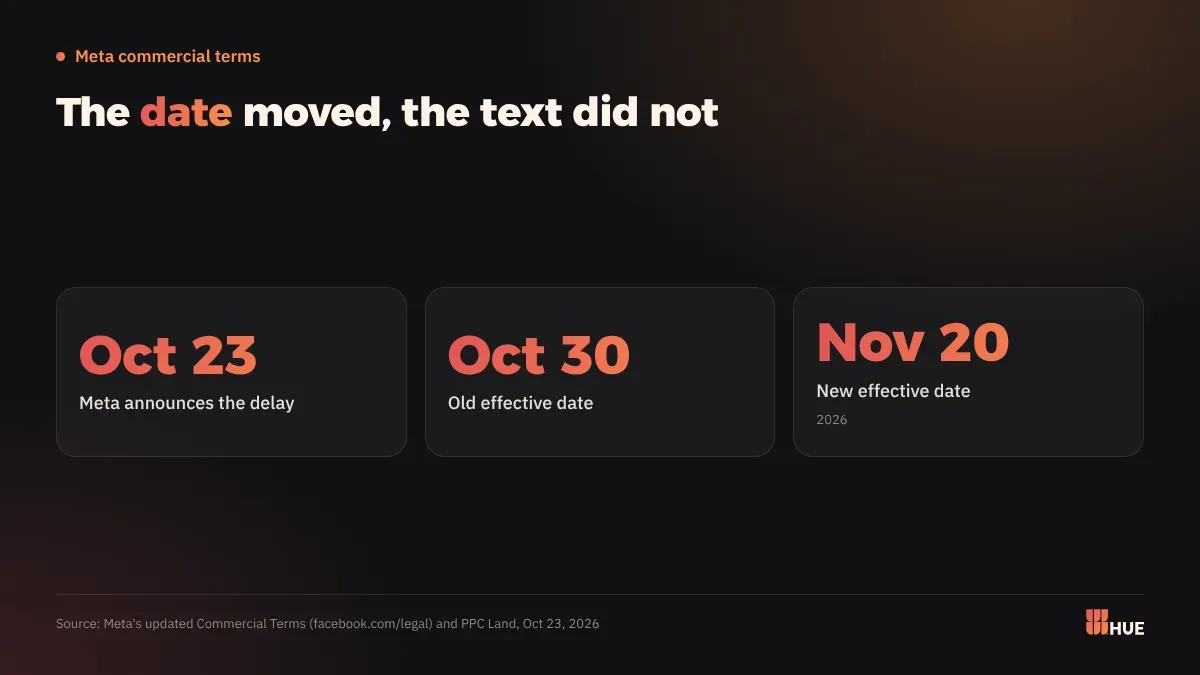
Meta has pushed back its updated commercial terms from October 30 to November 20, 2026. A Meta spokesperson announced the delay on Friday, October 23, saying the company wanted more time "to explain to our partners and stakeholders what's changing and what's not," according to PPC Land. Meta has not announced any change to the wording, which includes a clause that lets its crawlers collect content from websites tied to your business.
The updated Meta commercial terms now show November 20, 2026 as the effective date, in the English and Arabic versions. The delay also covers the Self-Serve Ad Terms, which govern ads you create in Ads Manager.
What exactly changed in the Meta commercial terms?
Only the date moved. The clauses that drew complaints are still there as published. For a website owner, these are the ones to read:
- Crawling your site: you authorize Meta, or anyone acting for it, to use automated software such as crawlers and bots on domains and URLs linked to your products or services. Those tools can access, index, cache, analyze and collect the content. The stated purposes are providing and improving Meta's ads and business products and keeping its products secure.
- AI features: the terms say these features may make mistakes. They also say you are "solely responsible" for the risks of using them and for the content they produce.
- Acceptance by use: if you keep using Meta products for business after the update notice, you agree to the new terms. The alternative the text offers is to stop using the products.
The terms never mention robots.txt. Meta's spokesperson said site owners can keep using it to signal crawling preferences, but PPC Land points out that this promise sits in a statement, not in the contract.
Most of the pushback came from news publishers in Europe and the UK. The European Commission welcomed the delay, and the UK's News Media Association called it "a pause not a solution." The Next Web reports that Britain's competition regulator has asked Meta to explain the terms, and that Meta still plans to go ahead.
Which Meta crawlers visit your website?
Meta lists five crawlers on its web crawlers page, each with a different job. The name is what shows up in your server logs and what you write in robots.txt:
| Crawler | What Meta says it does | robots.txt |
|---|---|---|
| FacebookExternalHit | Reads a site or app that someone shared on Meta's apps | May bypass it for security or integrity checks |
| Meta-ExternalAgent | Training foundation AI models or improving products | Meta gives an example of blocking it |
| Meta-ExternalAds | Improving ads and other business products | Meta gives an example of blocking it |
| Meta-WebIndexer | Improving Meta AI search results | Meta says allowing it helps it cite and link to you |
| Meta-ExternalFetcher | Fetches a single link when a user asks | May bypass it |
What does this mean for businesses in Saudi Arabia and Egypt?
Businesses in Saudi Arabia and Egypt are covered like everyone else: the clause applies to anyone using Meta products for business, with no exception by country. If you run a Facebook Page, an Instagram business account or ad campaigns, you accept the commercial terms, according to PPC Land. The websites and stores those accounts link to fall under the crawling clause.
WhatsApp is a different question. The terms do not name it, and we found nothing in the sources that settles whether a WhatsApp Business account on its own puts your website in scope.
The practical risk is content you exposed by accident: a quotation PDF on a direct link, a distributor price list, an open share link to an internal folder. The clause covers collecting content from pages tied to your business, and robots.txt is a request crawlers choose to honor, not a lock. Meta's own page says two of its crawlers may bypass it in some cases.
If you use Meta's AI features in ads or customer replies, a wrong price or refund policy in their output is your company's problem under the AI clause.
What should you do now?
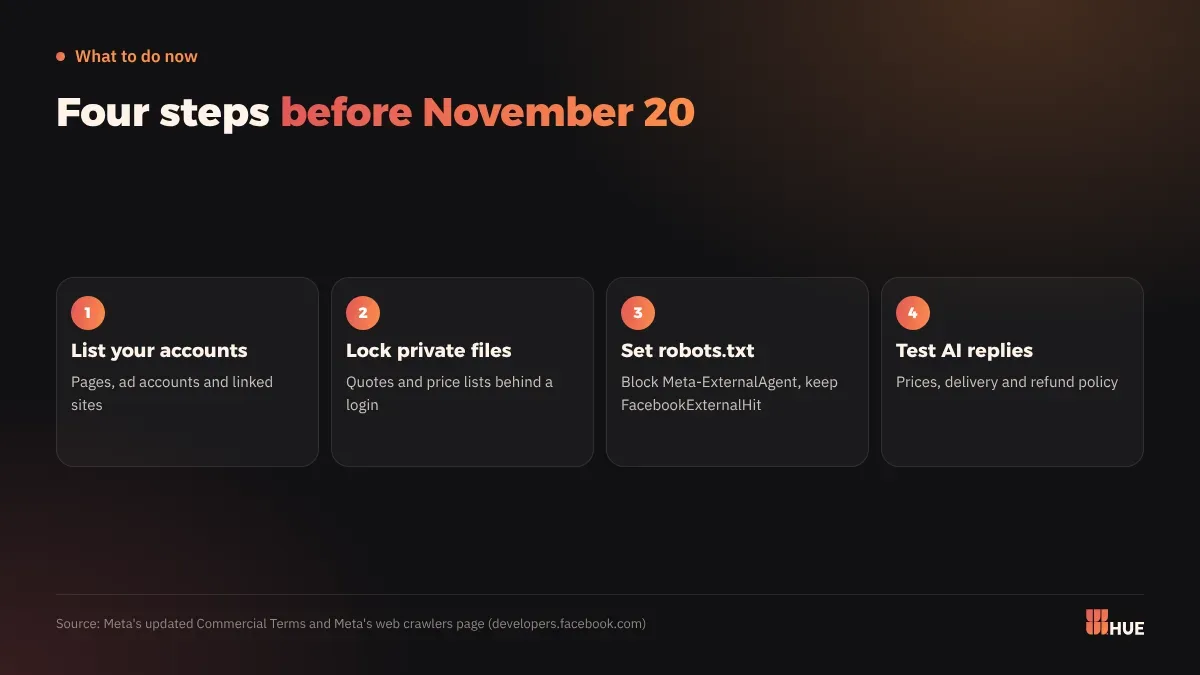
You have until November 20, 2026. Work through these steps in order:
- List your accounts and sites. Write down every Facebook Page, Instagram account and ad account you own, who manages each one, and the websites and stores they link to.
- Lock what should stay private. Move quotations, distributor price lists and internal files behind a login, and switch off open share links.
- Set your robots.txt policy for Meta's crawlers. To keep your content out of model training, block Meta-ExternalAgent with two lines: User-agent: Meta-ExternalAgent, then Disallow: /. Leave FacebookExternalHit allowed, since it is the crawler that reads your page when someone shares the link. Decide on Meta-WebIndexer based on whether you want to show up in Meta AI answers; we covered that trade-off in How to get your brand into AI answers.
- Test the AI replies. If you switched on Meta's automated features, ask them about your prices, delivery times and refund policy before a customer does.
- Keep a copy of the terms. Save the current and updated terms with today's date, and add a line to any agency contract saying who may accept platform terms on your behalf.
Questions
When do the new Meta commercial terms take effect?
On November 20, 2026, after Meta moved the date from October 30. Meta announced the delay on October 23 and has not announced changes to the text.
Can I reject only the website crawling clause?
No. The terms offer no way to opt out of one clause, and continued business use of Meta products counts as acceptance. Meta says robots.txt still works as a way to signal what its crawlers may access.
Will blocking Meta's crawlers break my link previews?
Blocking Meta-ExternalAgent does not affect FacebookExternalHit, the crawler that reads sites shared on Meta's apps. Keep FacebookExternalHit allowed in robots.txt.