AI training control in robots.txt: what Google and Bing announced
Google and Microsoft Bing announced new AI training controls for robots.txt on October 30, 2026. Google said on its Search Central blog that it plans to support a shared AI training control in 2027. Bing published new preferences on its blog, with deadlines that start on December 15, 2026.
This touches every business with a website, from an online store to a clinic or a factory. You now make two separate decisions. One is whether AI models may train on your content. The other is whether assistants such as Gemini and Copilot may use it to write their answers.
What did Google announce about AI training control?
Google will read a shared robots.txt signal that tells AI providers not to train models on a site's content. John Mueller of Google Search wrote that the signal comes from the IETF's AIPREF working group and that Google aims to support it with other AI providers in 2027.
- Google's crawler documentation names the signal __usage_ai-training and says support is planned for early 2027.
- If your site opts out of training with this signal and does not mention Google-Extended, Google will treat it as if you had disallowed Google-Extended.
- Each company's own controls keep working next to the shared signal.
- Google-Extended controls training of future Gemini models and the use of your content to ground Gemini answers. Google says it does not affect inclusion in Google Search and is not a ranking signal.
The IETF draft is not final. Search Engine Roundtable quoted a participant who said serious disagreements remain.
What are Bing's new AI preferences?
Bing now handles training and answers separately, and both default to Allow. Krishna Madhavan, Principal Product Manager at Microsoft Bing, wrote that site owners set two independent preferences:
- AI Training: Allow or Disallow, for the whole site in robots.txt or for a single page. A page setting overrides robots.txt.
- AI Grounding: page level only, with three options. Allow; DisallowExtended, which limits use to Microsoft products such as Bing, Copilot and Microsoft 365; or Disallow.
To block training across a site, add the line User-Agent: __usage_ai-training followed by Disallow: / to robots.txt. For one page, add a meta tag named Bingbot with the value ai-training:disallow, or ai-grounding:disallow for answers.
Bing says these preferences do not change a site's eligibility for traditional Bing results. It also warns that choosing DisallowExtended or Disallow for grounding will reduce your brand's visibility in AI experiences.
Which dates should you know?
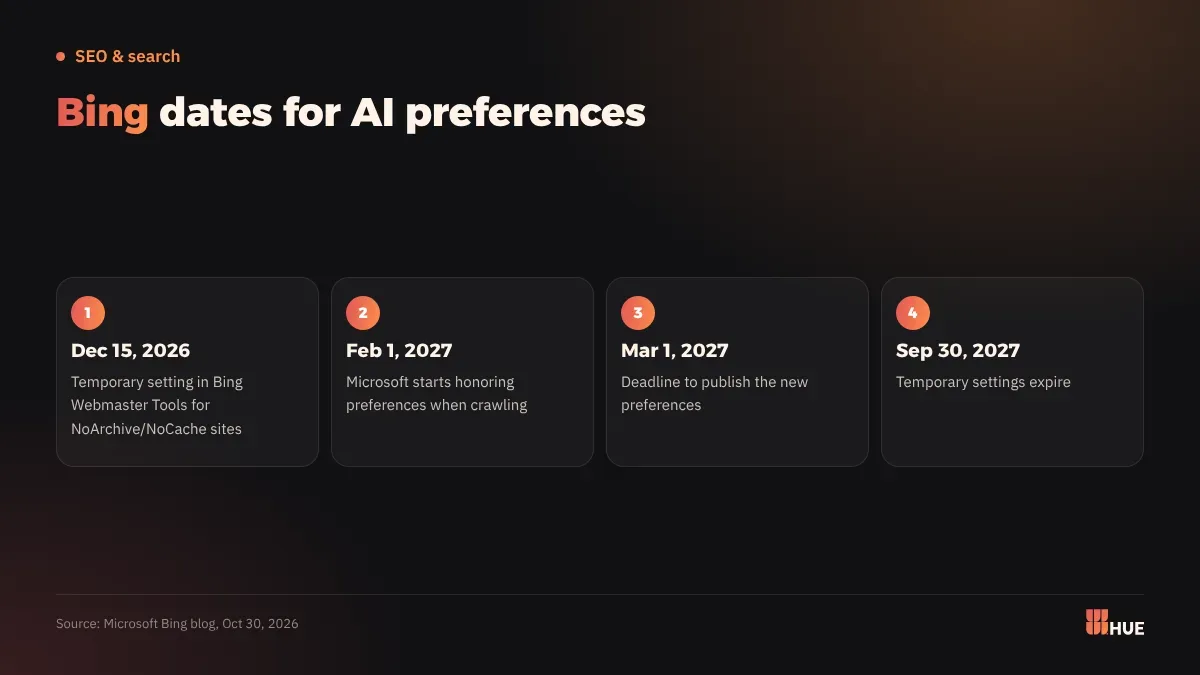
Bing set four dates. Google has only said early 2027. Bing's timeline:
- December 15, 2026: a temporary grounding setting opens in Bing Webmaster Tools, only for sites that use NoArchive or NoCache on that date.
- February 1, 2027: Microsoft starts honoring the new preferences as it crawls.
- March 1, 2027: the deadline to publish the new preferences. After it, Bing stops reading NoArchive and NoCache as training or grounding preferences.
- September 30, 2027: the temporary settings expire.
What does this mean for businesses in Saudi Arabia and Egypt?
Both announcements cover any site that Google and Bing crawl, and neither names specific countries. The same rules apply to a store in Riyadh and a company in Cairo.
Most businesses want customers to find them when they ask Copilot or Gemini about a product or service, so they should keep answers open. Training is a separate call. A company that sells original material, such as courses or reports, can block training on Bing and still allow grounding.
Google is less simple. Google-Extended covers both training and Gemini grounding in one switch, and Google says sites that explicitly allow it stay eligible for grounded Gemini answers. Add the shared signal without mentioning Google-Extended and Google will treat your site as if it blocked it. Our guide on getting your brand into AI answers covers the rest of that work.
What should you do now?
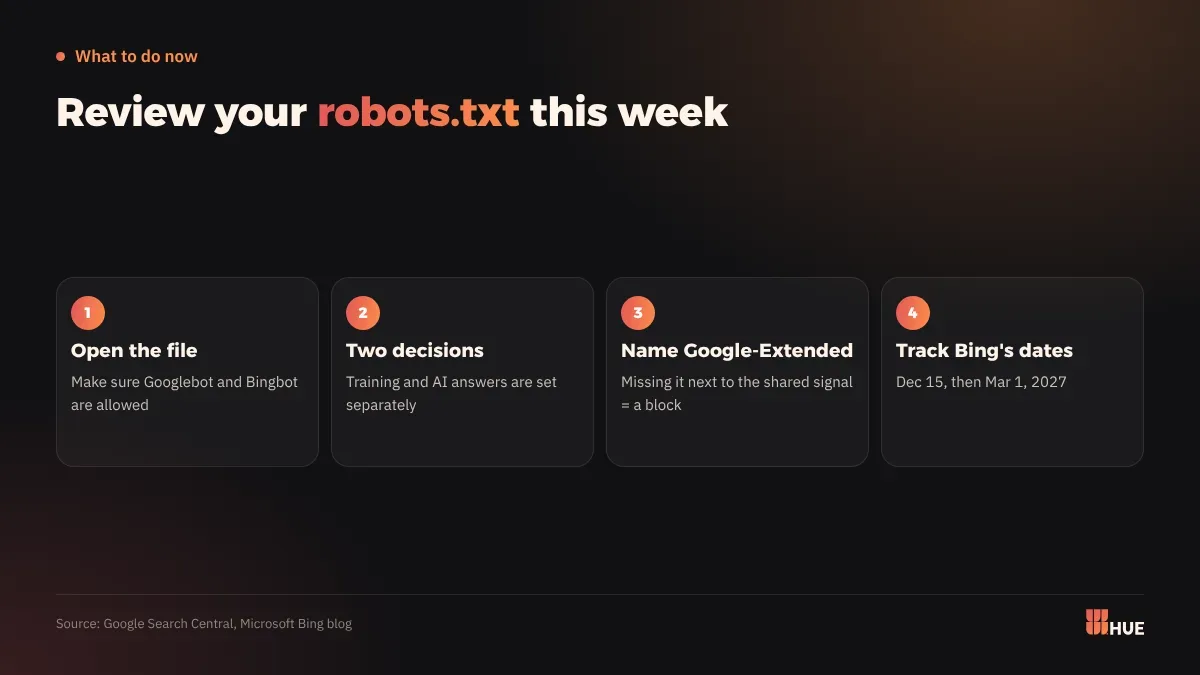
Review your robots.txt this week, before Bing's dates start:
- Open yourdomain.com/robots.txt and check the current rules for Google-Extended, Bingbot and GPTBot. Make sure Googlebot and Bingbot are not blocked.
- Decide on training and on answers separately. Write down the decision and the reason, so whoever manages the site next knows it.
- If you add the shared __usage_ai-training signal, state your choice for Google-Extended explicitly, because Google treats a missing entry as a block.
- If your site uses NoArchive or NoCache, record the temporary setting in Bing Webmaster Tools after December 15, 2026, and publish the new preferences before March 1, 2027.
- Set a reminder for February 2027 to check the file again once Microsoft starts enforcing, and to look for Google's date.
Questions
Will blocking AI training hurt my Google ranking?
No. Google says Google-Extended does not affect a site's inclusion in Google Search and is not used as a ranking signal.
When will Google read the __usage_ai-training signal in robots.txt?
Google's crawler documentation says it intends to support it in early 2027. It has not given an exact date.
What is the difference between AI Training and AI Grounding on Bing?
Training means using your content to build models. Grounding means using it to write answers in Bing, Copilot and Microsoft 365, and you set each one separately.